This year, we celebrate the 48th Earth day across the world. In 1969, Senator Gaylord Nelson decided to create an official day to celebrate the Earth and raise awareness of the environmental concerns he had after the devastating oil spill in Santa Barbara that year. The first Earth Day was celebrated on April 22, 1970. An incredible 20 million people attended celebrations and festivals around the country. It was a national event that was held to demonstrate support for the environment. The stage was set by Rachel Carson’s Silent Spring Book which raised public awareness and a concern for all living organisms. The book was sold in 23 countries and began a worldwide movement. It shared Carson’s compassion for the future of the planet and all living things on it. Since then, Earth Day is recognized every year across the world. At Maid Brigade, we’re proud to keep our earth healthy by using green cleaning products that are safe for the environment.
In 1990, a campaign began which would make Earth Day a worldwide event. This brought the environmental issues to a world stage that included 122 countries and over 200 million people. EarthDay.org states, "Earth Day is the largest secular observance in the world, celebrated by more than a billion people every year, and a day of action that changes human behavior and provokes policy changes.”
Earth Day will be celebrating its 50th anniversary in 2020. There are ways you can celebrate this special day in your own home.
Here are some things you can do:
Plant a tree in your backyard
Check the air pressure in your tires and make sure they are at the right levels for the best gas mileage.
Donate your clothing instead of throwing them out.
Try growing your own organic garden. You can start with an organic herb garden.
Wash your laundry in cold water and dry them on a line.
Lower the temperature on your hot water heater by 5 degrees.
Buy energy efficient light bulbs for your house.
Have an energy audit done in your home. This audit can be free.
Invest in a reusable coffee cup.
Use earth-friendly cleaning products.
Switch your bills to e-bills so you use less paper.
Check your faucets for leaks.
Be on the lookout for more of our earth-friendly tips this month!
For more green cleaning and green living information, check out Leslie’s website.
Dealing with dust allergies is a battle that affects many people, especially during the spring. To win the battle you need strategies that will help reduce the triggers in your home. Creating safe spaces where your lungs can “rest” is the key. Allergists refer to our immune system as a bucket that fills up over time. When our buckets become full we deal with allergic reactions. Each of us have different sized buckets, but we all need places in our homes where we can let our immune systems rest from dust, pollutants and irritants. Here are some things you can do in your home to create a clean and safe environment.
Cleaning more often – A simple, inexpensive step is to dust and vacuum more often. People in Europe use their vacuum to do most of their dusting. They use the dusting brush and go over all the wood and fabric surfaces with the vacuum. This makes cleaning quick and easy as well as very efficient. The vacuum captures and holds the dust. Wiping the dust with a dry cloth can put the allergens back into the air which defeats the purpose of cleaning.
Plants – Indoor plants are not only beautiful to look at, they also help clean the air we breathe in our homes. In fact, NASA calls plants “nature’s life support system”. By adding a potted plant like a Peace Lilly or Spider Plant to your home you will be naturally removing allergic toxins in your air. Place plants in the most used areas of your home, such as the living room and bedrooms..
Air purifiers – Our indoor air has been shown to be much more polluted than the air we breathe outdoors. We spend 90 percent of our time indoors, so it’s important that we clean it constantly. During most of the year we keep our windows closed to keep out the cold or heat. With limited air exchange we end up breathing the same air over and over again. Using a HEPA rated air purifier throughout the house will remove the allergens and keep pollutants to a minimum.
Mattress and pillow covers – We spend more than a third of our lives sleeping so an important place to focus on air quality is in the bedroom. Starting with your bed, find encasement covers for your pillows and mattresses to keep dust mite allergens away from your body. For some allergy sufferers, investing in hypoallergenic pillows and bedspreads may be the best solution. Down pillows are soft and very comfortable but can trigger allergies while you are sleeping. Wash pillows and blankets often in very hot water and dry on a hot setting to kill dust mites and remove their droppings
Remove stuffed animals and draperies – Dust accumulates in fabrics. Since we don’t dust or wash our draperies every time we clean, they tend to collect a tremendous amount of dust which can be a trigger for those suffering from dust allergies. Stuffed animals also collect dust in a child’s room and can trigger an allergic or asthmatic reaction. The safest alternative is to completely remove drapes, curtains and stuffed animals - especially in the bedroom. Instead, use hard window treatments such as window blinds and shutters. If your child has trouble parting with their favorite stuffed animal, place it in a pillow case once a week and wash it in hot water and dry on a hot setting.
Considering hard flooring vs carpeting – Carpeting, like draperies, are dust magnets. Even the best vacuum can’t remove all the dust and dander from a carpet. Allergist recommend removing all the carpeting in a home and replacing it with hard wood flooring. Hard floors are much easier to keep clean and the dust can be kept to a minimum. However, removing carpet throughout a home and replacing with hardwoods can get expensive. For a more economical solution, we recommend a professional carpet cleaning to reach the harmful dust mites hidden below the surface.
HEPA rated vacuum – Make sure you have a high-quality vacuum that has a HEPA rated filtering system. There are many different vacuums advertising they are good at removing allergens, but make sure you research the brand before making a purchase. There are only a few vacuums that are rated HEPA. Remember that you want to look for a vacuum that is rated HEPA not a vacuum that uses HEPA rated filters. A vacuum rated HEPA cleans the surfaces it touches as well as the surrounding air you breathe.
Dust mite sprays on furniture – Some people ask if dust mite removal sprays work and the answer is yes, but you need to be careful should someone in your home also have a chemical sensitivity. Spraying your fabric furniture with these sprays will kill the dust mites living in them, but they also add another type of pollutant to your air.
Keep humidity low – Dust mites like dark, moist environments so keeping the humidity low in your home is a great way to combat dust mites naturally. Use a dehumidifier all year round to keep the moisture in the air below 50%.
Keep pets out of the bedrooms – We all love our pets but their dander can be a trigger for someone dealing with allergies or asthma. Keep pets out of the sleeping area of someone dealing with allergies.
For more green cleaning and green living information, check out Leslie’s website.
For other allergy and asthma health tips, read these blogs:
A case of lice does not reflect a lack of cleanliness or personal hygiene as some would like to think. Head lice cause itching and discomfort but are not found to transfer dangerous diseases in the United States like lice in other countries. Here are answers to the most common questions about lice:
How can I get infected with lice?
Head lice can be transferred by sharing things like brushes, combs and even hats. They can transfer from direct head-to-head contact and lice can transfer from pillows and sheets too. But there is no evidence that lice are transferred from pets to humans.
Do head lice jump from person to person?
Head lice don’t have the body type to jump. They are transferred only by direct contact.
How long do lice live?
Lice can only live 24 hours without a host, but with a host they can live up to 30 days. Lice reside in pillows and sheets and return to the host for feeding. Lice, like bed bugs, bite their hosts for blood. Their bites are annoying and itchy but are not dangerous unless they get scratched and infected.
What’s the best way to rid lice from hair?
Some feel that they should treat for lice even when they only suspect that there is an infestation. There are no shampoos that totally kill head lice and their nits so manual removal is the only solution. Wash hair with a specialized, over-the-counter shampoo, rinse completely and then go through hair with a nit comb. Remember that the shampoo is extremely strong and toxic so overuse is not recommended.
Two different types of louse combs used when treat of head lice.
How do I remove lice from my home?
Removing lice from your home is an extremely labor intensive project. All fabric furniture must be completely vacuumed. Pillows and stuffed animals should be put into a garbage bag for 10 days to make sure that any nits that hatch in that time period die, separated froma host. Other items can be put into the dryer for 30 minutes on a high heat. All sheets, pillows and comforters should be washed and dried on a hot setting. The entire house should be cleaned before treating the infected person.
How do I know if I really have head lice?
Persistent itching can be indication that an infestation exists. Professionals use a magnifying glass or a florescent light although some feel the florescent light highlights hair lint as well as nits and confuses the diagnosis. Regardless, lice are normally visible with a magnifying glass.
For more green cleaning and green living information, check out Leslie's website.
May is Asthma and Allergy Awareness Month. If you have someone in your household who suffers asthma or allergy attacks, these 5 key areas of your home need special attention while you are spring cleaning this year. Lifestyle Expert Michelle Yarn shares advice from Maid Brigade on how to control allergies indoors, in this new video:
When it comes to cleaning for health, Maid Brigade wrote the book. Our Green Clean Certified® system uses cleaning solutions and equipment that are designed to be safer yet equally effective to traditional cleaning systems, that can make you sick. Using green cleaning products and equipment is one important way to control allergies indoors. Another is to focus on the 5 key areas in your home to address, described in the video above.
Maid Brigade has dedicated ourselves to educating the public on safer alternatives, and we have a TON of "how to" info for the DIY cleaner. You can check out some recent examples by clicking on the titles below.
If you don't want to clean for your self anymore, or if you need help every once in a while (like, maybe right before your Memorial Day party!) give us a call at 888-79GREEN or click below to get a free, no obligation estimate:
All Maid Brigade cleaning crews are uniformed, trained, Green Clean Certified® and insured. We pay all local, state and federal taxes. Our professional cleaners are Maid Brigade employees.
Someone I know has another friend who recently told my friend that she purchased the perfect vacuum and that my friend should buy one too. Maybe it's happened to you too. Before we even think about the type of floors our friend might have, we look up that vacuum up on the internet. But since none of us have the same home it doesn't make sense that we consider a vacuum for ourselves that is perfect for someone else. Whether you realize it or not a vacuum is a very important appliance for your home. It deserves some thought and research before you buy it. Here are a few tips to help you chose the best vacuum cleaner for your home.
What type of vacuum cleaner do you want
Different personalities like different types of vacuums. Upright people are pushy – meaning they like to push things around. They don’t like the idea of dragging something around behind them. Canister people don’t like the weight of an upright and prefer to just handle the pipe and hose. They don’t mind something following behind them. Decide which type of vacuum you prefer and shop for that style of vacuum.
Is weight an issue
If you have a bad back or shoulder issues, don’t even consider a heavier vacuum. But remember that the weight of the vacuum is directly related to the vacuum’s suction. Light weight vacuums are easy to use but don’t have very big motors. Heavier vacuums have large motors and great suction, but will be difficult for you to use. Decide whether you prefer a light weight vacuum or one that has great suction. Unfortunately, you can’t have both. At least not in the same unit.
The best way to clean hardwood floors
For hard wood floors, you might consider a canister vacuum. The soft floor brush that comes with a canister is the absolute best way to clean a hardwood floor. You won’t even need to use a dry mop after using this type of attachment. The bristles of the floor brush work incredibly well at picking up dirt and hair and will leave the floor looking perfect.
If you have allergies
Everyone loves the convenience and cost savings of a bagless vacuum cleaner, but think twice about purchasing one if you have dust allergies. Dumping the dirt container exposes you to concentrated amounts of allergens and dust mites. You would need to use a mask and gloves to avoid being exposed to all those allergens. Another little known fact about bagless vacuums is that the filters need to be replaced every 6 to 12 months to keep them working efficiently. This can cost up to $60 for each filter change, depending on the model of the vacuum. These costs are an important consider when you chose the right vacuum.
If you have pets
If you have pet hair, you need to have a very aggressive beater bar in your powerhead. Look for very stiff bristles on the beater bar along with incredible suction power to suck up the hair and dander in your carpet.
Stairs
The right vacuum for stairs should have a hose attachment that can reach at least ¾ of the way up a staircase. You don’t want to be fighting with a heavy, cumbersome vacuum while cleaning your stairs.
Reach
Manufacturers call this a “cleaning radius”. A canister vacuum can clean up to 35 feet from the plug in the wall. A vacuum’s cleaning radius should be something to consider before making your purchase. The information should be listed in the manufacturers details of the vacuum. Nothing is more frustrating than finding your new vacuum won’t reach where you need it to clean.
HEPA filtration
If you deal with allergies, you want to choose a vacuum with a HEPA (High Efficiency Particulate Arrestance) filter. You especially want a HEPA rated vacuum if you or a family member has severe dust allergies. The best HEPA vacuum has a sealed system meaning that there are no leaks in the entire system. Watch out for the labels HEPA-type or HEPA-like. These are vague ratings and don’t actually mean the vacuum is rated HEPA. A real HEPA filter removes allergens down to .03 microns. The technical specifications on the vacuum will tell you the filter’s efficiency.
Research the repair records
Some manufacturers don’t even supply repair parts for their appliances. Do a little research on the different models you are considering. You don’t want to have to purchase a new vacuum just because of a minor (but un-doable) repair on your old one.
Your vacuum is an investment
Choose the right vacuum for your home. People spend more on a week’s groceries than they do on their vacuum cleaner. Yet they get frustrated when it doesn’t work correctly. There are quality vacuums on the market that will last decades for a small investment. These models are worth the extra money. You may save a few dollars with a disposable model, but over the years you will save hundreds of dollars by purchasing a good quality vacuum. And, your home will also be cleaner and your health better protected.
Leslie Reichert is a cleaning expert that uses her sparkling personality, great sense of humor and contagious passion to encourage her fans and followers to think differently about what they are using in their homes. Leslie is known as a Green Cleaning Coach and she is changing the world - "one spray bottle at a time". She is a national lecturer, a frequent homekeeping expert on The Dr. Oz Show, Martha Stewart Living Radio, Maid Brigade’s DIY Cleaning Expert and author of the book: The Joy Of Green Cleaning- a handbook for DIY cleaners. She works with Better Homes and Gardens, Real Simple, Today.com and other national publications. You can see more of her work atwww.greencleaningcoach.com
Every year, 1 in 6 Americans get sick from food-borne illnesses. These illnesses, also called food poisoning, also send about 128,000 people to the hospital, resulting in about 3,000 deaths nationwide each year.
Bottom line ~ food-borne illness can be more serious than we think.
Causes of food poisoning are mostly microorganisms, like viruses or bacteria. And although many of these microorganisms cannot be seen, smelled, or tasted, they can cause an illness that ranges from mild to life-threatening.
Food-borne illnesses are mostly picked up in areas where food is prepared as well as eaten, such as restaurants, schools and even our homes. Food-borne illnesses can also be acquired from contaminated drinking water, and water found in swimming pools. Microorganisms can even be passed from person to person, which is why proper hand washing is extremely important!!!
Food-borne illnesses can have a variety of symptoms, but the most common symptoms are nausea, vomiting, abdominal cramps, and diarrhea. Always check with your doctor if you are experiencing any of these symptoms.
To keep your kitchen clean, and those pesky unwanted microorganisms at bay, follow these great tips:
Wash hands properly and often. If your hands are not clean, chances are you're spreading bacteria and virus germs all over your food, your utensils, the kitchen counter tops, and even your family!
To properly wash your hands, scrub your hands with soap and warm water for twenty seconds, making sure to get under the nails and in between the fingers.
When preparing to cook, pre-clean your work area with an all-purpose cleaner. THEN, spray disinfectant on the surface, letting the disinfectant soak for a few minutes. After about five minutes, wipe the surfaces with a microfiber cloth. (For cutting boards, use natural anti-microbials like lemon juice, white vinegar or tea tree oil.) It's very important that you clean the surface before disinfecting it.
After each use, wash all surfaces, including kitchen counter tops, cutting boards, and even utensils. Be sure to use warm to hot soapy water. Don’t forget to wipe down other surfaces and areas that have been touched in the kitchen, such as drink dispensers on the fridge door, light switches, spatulas, and all handles, controls and faucets.
Wash all fruits and vegetables, before and after peeling them.
Do your best to separate raw meat, eggs, seafood, and poultry from the rest of your foods in the fridge. When cooking or preparing meals, always use separate utensils, plates, and especially cutting boards for all uncooked produce and uncooked meat, seafood, eggs and poultry.
Learn to love your thermometer! When cooking foods, it is important to cook food to the proper temperature, and for the proper amount of time. This way, the food is heated up enough to kill the harmful viruses and bacteria that could potentially cause illness. Use a food thermometer be sure when food has reached its safe minimum cooking temperature. For example, when cooking, all poultry should be cooked to a temperature of 165 degrees Fahrenheit, and 160 degrees Fahrenheit for ground meats. Microwave foods thoroughly to 165 degrees Fahrenheit.
At meal times, when food is being served and eaten, keep the food hot, at about 140 degrees Fahrenheit or greater.
After meals, refrigerate leftover food quickly. Illness-causing bacteria and viruses can grow in many foods within two hours unless you refrigerate them. During the hot summer weather, it only takes one hour for illness-causing bacteria and viruses to grow in foods.
Make sure you marinate or thaw foods in the fridge and not in the kitchen sink or on the kitchen counter.
Refrigerate all perishable products as soon as possible after grocery shopping. Learn the “two-hour rule,” which states that perishable foods should not be left at room temperature longer than two hours. Harmful bacteria have the tendency to multiply in the danger zone, which is between 40 and 140 degrees Fahrenheit.When temperatures are above 90° F, as they often are in cars that have been parked in the sun, modify that rule to one hour.
If you are traveling over one hour with groceries in your car, use an ice chest or cooler to keep frozen and perishable foods cold.
Where the weather is warm and the air conditioner is being used in the car, keep your groceries in the passenger compartment, not the trunk.
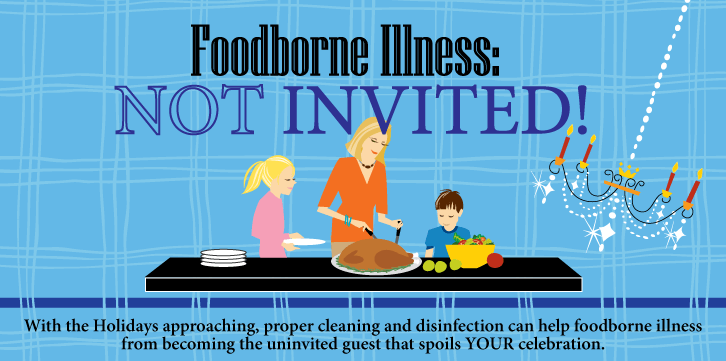
With the holidays approaching, proper cleaning and disinfection can help food-borne illness from becoming the uninvited guest that spoils your celebration! Educating yourself on how to properly safeguard your home and family against food-borne illnesses is one of the best things you can do to prevent any food-borne illness from taking over!
Show this blog and infographic to your family - where food-borne illness is concerned, knowledge is power!
Do you realize the dust in your home is probably toxic? The Silent Spring Institute, dedicated to researching the effects of toxic chemicals on health, recently conducted a study testing the presence of 45 synthetic chemicals in household dust. There were 10 chemicals that were present in 90% of the samples tested. This suggests toxic household dust is everywhere.
I was fortunate to be able to interview one of the scientists from the study and I’d like to share some of the highlights of our time together.
Robin Dodson is a research scientist that specializes in chemical exposure and risk assessment. Robin and her colleagues found that there are a wide range of toxic chemicals in our household dust. This may be the reason why our homes are considered more polluted than outdoor air.
Robin explained that the chemicals in our homes are interacting with the dust. The dust actually becomes a reservoir for the chemicals. The dust shows the scientists a snapshot of the toxins that are in a home.
Of those 10 pervasive chemicals, Robin and her team identified two as the worst. Phthalates, which are considered hormone disruptors, were found in every sample – the worst offenders. Phthalates can be found in plastic toys, vinyl and the fragrances in household cleaning and personal care products. By law, the formulas of these fragrance components are considered “trade secrets” and manufacturers are not required to disclose such ingredients on package labeling. This makes it extremely hard for consumers to really know what’s in any given product that has a fragrance.
Phenols, chemicals found in cleaning products, were the second biggest offenders. Phenols are used in synthetic fragrances found in cleaning products, body care products and perfumes. They are considered hormone disruptors.
The takeaway is that the scents we smell after using a cleaning product do not disappear. They are still in our homes even after their scent goes away.
Body care product manufacturers are required to list their product ingredients on the package label. But unfortunately, cleaning product manufacturers do not have to list their ingredients so you MUST do research if you want to find out what they are using in their products.
Children suffer the most from exposure to these chemicals. Their bodies are still developing and their exposures are proportionately higher doses than adults due to their small size. Children also spend a lot of time on the floor, commonly putting their hands in their mouths. Therefore they are ingesting toxic household dust! Pets are also at risk, spending a lot of time on the floor and exploring their environment with their noses and mouths.
There are some simple solutions to removing toxic household dust from your home. Vacuuming often with a HEPA-filtered vacuum cleaner is one simple solution. The other is to have your children wash their hands often. And finally, try to avoid products that contain synthetic chemicals, especially fragrances.
Silent Spring Institute has a free app, called Detox Me that will help you think differently about the chemical load you may have in your home. Their app shows you where there may be a problem in your home and gives you alternatives.
OR, what do a clothes dryer, a pillow case and a hair dryer have in common?
When the weather turns colder we close our windows and it seems that everyone starts getting sick. Most of the “sickness” is really a reaction to dust and allergens that are hiding in our homes. Hiding??? Yup, hiding throughout your house. If you or someone else in your house notices more congestion, more sneezing or coughing, this could be your problem.
A really good vacuum with lots of attachments isn’t the only way to reduce these irritants indoors. And besides, it’s big and clunky, puts off heat when operated and it’s all the way down in the basement. Instead, try these surprisingly easy tricks to get rid of allergens in your home – and your sickness.
Fluffy deep pile rugs – Rugs in general are dust magnets but those new designer rugs that have long shaggy pile are the worst. Dust, dust mites, pet dander, pet hair and other allergens get embedded deep within the fibers. Put smaller size rugs right into your clothes dryer to remove the allergens. As you will discover in this blog post, your dryer is possibly your best weapon against allergens in your home. The heat of the dryer kills the dust mites and the air flow frees the allergens and exhausts them outside.
Throw Pillows – Throw pillows accumulate dust just like your wood furniture. I think I’ll dust them today. Says no one, ever. And you can’t, really, anyway. You can clean them with the upholstery tool on your vacuum OR simply take them outside and give them several good whacks to dislodge dust and other microscopic irritants, then use your trusty dryer to kill and remove the remaining, more deeply embedded allergens.
Book Shelves – Books hardly ever get dusted when we clean. Yes, we dust the shelf they are sitting on, but never the tops of books. Ever watch a movie and see the dust they blow off when they pull an old book out of a shelf in the library? It’s exaggerated in the movies, but commonly occurs on a lesser scale in an average home.
Books get really dusty. You can quick clean them on the shelf by using a really good feather duster or your vacuum and the upholstery attachment. But if it’s been a while, a deep clean may be in order: pull all the books off the shelf and dust all six sides of each with a microfiber cloth. Microfiber grabs and holds dust and other allergens while other dusting rags just move dust around. If you’ve got allergies, you need microfiber for a really thorough job.
Draperies- Drapes and curtains are the worst place for dust and allergens to accumulate. Most allergists recommend removing window dressings completely when someone has been diagnosed with dust allergies. If you can’t live without draperies or curtains, there are a couple ways to keep the allergens at bay. Vacuum your window treatments on a bi-weekly basis using your vacuum and upholstery tool. Once a month, take them down and place them in the dryer on high heat. Keep this regimen and you will never need to go through the entire process of washing, drying and pressing your curtains.
Lamp shades – Pleated lamp shades never really get dusted. You may dust the top of the pleats of the shade by “blotting” with a microfiber cloth (you don’t want to push particles into the weave of cloth shades) BUT the real allergens are hiding deep down inside the pleats. Use your vacuum and the upholstery tool to draw dust out of the pleat. Then use a new paint brush and brush down inside the pleats to loosen the dust nestled there. Finish by vacuuming the entire shade one final time.
Artificial plants and flowers – Allergens LOVE to hide in dry flower arrangements and on artificial plants. Artificial arrangements tend to be overlooked when we are dusting. A simple tool you can use to clean the dried flowers is a hair dryer set on a gentle setting. Do this outside or in the garage, if possible. To clean plastic plants, simply use a spray bottle of water and a dry microfiber cloth. Spray the leaves and wipe them dry with the microfiber cloth.
Stuffed animals – If your child is diagnosed with allergies the first thing your allergist will recommend is bag up all your child’s stuffed animals. These, like throw pillows, are a haven for dust and allergens. If your child just can’t part with these beloved friends, place them in a pillow case and pop them in the washer twice a month to keep the allergens to a minimum. If they can safely be dried, use the dryer.
Ceiling fans – Perhaps the most overlooked item on a routine clean is the ceiling fan. Before you know it, there’s a nice film of dust building on the edges of the fan paddles. What you can’t see is the buildup on top of those paddles. A quick and easy way to fix this is with a pillow case. Place the pillow case over the fan paddle and, holding it closed at the base of the paddle, pull the dust off. Carefully open the pillow case and repeat on the remaining paddles. Then just put the pillowcase in the washer. No more allergens!
Summertime heat and humidity brings out all sorts of pests that you don’t want in your home. If you are trying to stay away from toxic chemicals, the last thing you want to use is a toxic pesticide to get rid of them. Here are some natural ways to rid your home from these nasty pests.
There are usually two types of ants we see in our homes. Those big black ones are carpenter ants and then those tiny ones are sugar ants. You can use this simple recipe to get rid of either. Use a ½ cup of borax and ½ cup of sugar mixed together and sprinkle it anywhere you see the ants. The sugar will attract the ants and the borax will dehydrate them and kill them without poison.
A fly infestation can drive you crazy. Did you know that flies hate the smell of basil? You can use basil plants by windows or place dry basil in muslin bags and tuck it in corners around your home.
Spiders don’t like the smell of citrus so you can mix up a spray bottle of citrus oil and witch hazel and spray it around window screens and window ledges. The citrus smell will keep them outside where they belong.
Ants use trails to remember where they’ve been so use vinegar to wipe away their trails. Just mix up a spray bottle of distilled white vinegar and water and spray the areas where you’ve seen an ant. The acid in the vinegar will destroy the trails and they won’t know how to get back to that spot.
Wasps won’t build a nest where there’s another nest. Wasps are very territorial so all you need to do is build a fake nest to keep the real ones away. You can put a fake one in the front yard and another in the back yard and wasps will leave your yard for a safer place.
Mosquitoes hate catnip and Listerine®. To keep mosquitoes away from decks and patios, just plant some catnip around your other flowers and your garden will work to repel mosquitoes. If you are looking for a safe mosquito spray, just put some Listerine in a spray bottle and spray legs, ankles or any place you’re getting bitten.
If you have dogs or cats that go outside, you may be dealing with fleas this summer. But something as simple as salt can work to kill the fleas. Fleas take 9 days to complete their hatching cycle so treat your carpets every three days with a sprinkle of salt to keep the fleas away. You can also place a pan of dish soap and water next to a night light in the evening and they will hop in and drown.
If you deal with dust mite allergies you can use cinnamon sticks under your furniture cushions to repel the dust mites.
Fruit flies are so annoying and can come into your kitchen on fruit from the grocery store or from rotting food in your disposal. Make sure the disposal is cleaned and sealed so the fruit flies can’t keep going into it. Also place your fruit in sealed plastic bags or in the refrigerator to kill the flies. To get rid of the ones you have, fill a container with red wine and a few drops of dish soap. The wine will attract them and they will drown in the soap.
If you are dealing with deer eating your plants or flowers you can deter deer with Irish Spring soap. Just cut some shavings of the bar and place them around the plants or flowers the deer are eating. Once they smell the soap they will be off to your neighbors’ garden.
Seeing signs of mice in your home? Mice don’t like the smell of peppermint so you can repel them by buying some peppermint oil and placing a few drops on cotton balls. Place the cotton balls in the corners of cabinets or corners of rooms where you think they might get into your home. Reapply the oil every 30 days
Roaches are so disgusting and really difficult to get rid of once you have them. I bet you didn’t know that they don’t like the smell of Tabasco® sauce. So to get rid of those sneaky pests just mix up some Tabasco sauce and water and spray the mixture in corners of your kitchen and bathrooms. The roaches will be on the run once they smell it.
Bed bug infestations are scary and seem to take a lot of work to get rid of them. A simple treatment of diatomaceous earth can do the trick without any other chemicals. This natural dust has very sharp edges to it and works to “cut” the bedbugs so they die. Then vacuum up the carcasses along with the diatomaceous earth. Place this dust in areas that you suspect have an infestation. Be careful not to use around pets as the dust can aggravate their breathing and get into their eyes. Another simple solution is to spray the area with rubbing alcohol. Just spray every day to kill off all the bed bugs.
Everyone thinks that lice is a sign of a dirty home but actually lice are parasites that travel from person to person very easily. A simple treatment is to use mayonnaise like a hair conditioner. Put a thick coat of mayonnaise on your hair and wrap in a plastic shower cap. Have a good night’s sleep and when you wake up the lice will be dead. Just rinse your hair and you will have hair with a lovely sheen and will also be lice free!
Clutter may seem like chaos at first glance, but what if there are hidden treasures lurking in your stacks of mail and unfolded laundry? Rather than declaring every piece of clutter a nuisance, Maid Brigade encourages you to rethink your approach to your home’s messes and consider the surprising benefit and value forgotten items can bring.
With careful organization and a bit of attention, you can transform clutter into a purposeful part of your space. In this blog, we’ll help you differentiate between junk and metaphorical jewels so you can bring peace, order, and joy to your living space.
Clutter or Hidden Gem?
The first step in addressing clutter is adjusting your frame of mind. What may seem like an unwanted mess could actually be objects with sentimental, practical, or aesthetic value. Think of that stack of old magazines — could they be repurposed for creative projects or serve as nostalgic keepsakes? What about those kitchen gadgets collecting dust? Are they tools for a hobby you’ve neglected but still love? What if a friend or relative has been dying to get a stand mixer, and yours is just sitting there, unused and in the way? The truth is that some elements of clutter can enhance your home when given the proper context. Plus, any items you do deem “unwanted” may be valuable to someone else. Whether you’re donating or gifting, don’t forget that every mess in your home has the potential to be perfectly repurposed.
Organize with Intention
To fully unlock the potential in your clutter, focus on thoughtful organization. Start by sorting items into categories: keep, donate, recycle, or toss. Keep what adds value to your life, and let go of the rest. Use storage solutions like baskets, bins, and shelves to create an orderly home where everything has its place. For items you cherish but don’t use daily, such as photo albums or family heirlooms, consider creative ways to display them or store them safely. A little structure can turn a chaotic pile into a collection of memories and treasures.
The Beauty of a Well-Curated Space
Once your clutter is sorted and organized, you may find that your home feels more inviting and functional. You may also feel more inclined to invite guests or revisit projects and hobbies you previously didn’t have the space for. Clear countertops, tidy shelves, and neatly arranged spaces not only reduce stress but also boost your overall well-being. Like a breath of fresh air, a clean home is a reminder that you have all the space you need to relax and make time to enjoy the things that truly matter.
When to Call in Reinforcements
While daily tidying and organization can do wonders, some tasks require more time and expertise than you might have. Deep cleaning, tackling hard-to-reach areas, or refreshing your home after a renovation are all jobs best left to professionals. That’s where Maid Brigade steps in. With our eco-friendly PUREcleaning® system, we make your home shine without harsh chemicals and residues.Imagine your space transformed — a cleaner home, a healthier home, and a better future. Contact your local Maid Brigade today to discover how we can help you turn your cluttered home into a sanctuary of order and beauty.
As with life, clutter happens. Drawer by drawer, room by room, inside and outside, hidden or visible, clutter begins to creep up and expand right before our very own eyes. The good news is we can actually learn to control the clutter before it takes over our homes by getting down to the root of the problem – ourselves.
According to Maid Brigade's consumer research, a disorganized, messy home can cause personal discomfort, anxiety and depression. Clutter creates safety hazards, too. And it creates more surface area to collect dust, dust mites, pollen, pet dander and other allergy and asthma triggers - a big deal especially this time of year. So....controlling clutter can help improve quality of life.
But before we even begin to lessen our stress by de-cluttering, we need to understand exactly why we clutter in the first place. Is it a personality "quirk" or is it triggered by certain events, people, emotions or other stimuli? Or do we just have too much stuff? Or is it a result of over-committing in work, the community, church, children's schools, or other areas? Very few people actually enjoy straightening and cleaning, so we become very adept at making other things - anything - a higher priority.
Before trying to tackle clutter, taking an inward look can help understand the root of the problem. And this understanding may lead to a permanent solution. In addition to understanding, you need techniques to control, contain and clear out clutter.
Here are 7 common clutter scenarios and tips to get past them:
Piles. Many people who are not even sure what clutter is. This is why a problem goes unnoticed until the situation is way out of hand. When valuable or cherished items start turning into “piles of stuff”, the cluttering process has begun. Find a place to store these items together, out of the way - in a drawer, cabinet, cubby or closet.
Collections. The items we cannot let go of, the sentimental items that bring us joy, we become emotionally attached to. but how long is it appropriate to hold onto items? When should we know it’s time to start donating, selling, tossing, or keeping them? A good rule of thumb is to visit these collections once a year (if you don't, do you really need to keep them???) to both enjoy them and ask yourself, "Is it time to say goodbye to this item and keep its memory in my heart?" Be honest. Letting sentimental items go, or storing them properly, is a big part of the de-cluttering process.
Spatially challenged. The question, “how long should I hold on to something?” goes hand in hand with, “how do I store things the correct way?” Not knowing how to store your items properly always ends up as clutter. Search online for products that can help you organize clothes, shoes, craft supplies, work tools, magazines and more. Looking at the product shots will help you improvise solutions that can work, even if you don't buy the products.
No routine. Without set routines for cleaning, storing and organizing, the house and everything in it will quickly become a complete mess. Learning to de-clutter one drawer a day, or fifteen minutes each day, or any set practice can help establish a routine that will help tremendously with clutter control.
Container aversion. Sometimes people prefer not use storage containers because they tend to be expensive and can at times cause more clutter. If this is the case, try using small boxes, jars, trays, Ziploc bags, hooks or baskets to store smaller items such as remotes, mail, nail polishes or rubber bands.
Micro clutter. Your clutter is always the same types of items. As crazy as it sounds, some people tend to clutter up the same specific areas of their home but be neat in others. For example, the kitchen cabinets might be spotless and organized to the max, but the pantry is a disaster. Or, the dresser drawers are neat and organized but the closet is a mess. If this is you, find a way to dial this area into your routine, then stick to the program. The good news is, because this is isolated clutter, it won't take long to address if you do it often.
Abundance. Buying more then you need is a biggie and it comes in all forms. People go on shopping sprees and buy clearance items, not because they need them but because they are on sale. Others will buy items because they are “cute” but will never use them. Some of us even buy the latest and greatest items and only use them once. Then there are the “dream” buyers, who sign up for yoga, cooking, or painting classes, buy all the equipment, and never go back to class. Be smart and think before you buy! Or adopt the one-in-one-out rule: if you buy something new, something else must be donated, recycled or handed down.
If clutter is a problem for you, take some time for introspection, then use the scenarios and tips above to help you get clutter under control, once and for all. With the clutter, away will go anxiety, depression and poor quality of life. Although it may not be enjoyable, de-cluttering has very important benefits. You'll see - even small accomplishments will have a positive results, making it easier to achieve more. Just like in life.
As I lock up the house for the evening and begin walking towards the bedroom, I reflect on the long day I had and how I cannot wait to snuggle under the covers in my bed, turn on the tv and relax. The closer I get to my bedroom door, the happier I get. The only thing that could ruin this yearning desire to relax in bed is to walk into a filthy dirty room.
There have been many times in my life where I have come home to a messy bedroom. After a hard day at work or even after a fun night out with friends, the last thing I want to do is look at piles of clean laundry sitting on the bed waiting to be folded, or stacks of paperwork piled high on the night stand next to this morning’s empty coffee cup and leftover breakfast plate. Whether we want to believe it or not, a messy environment can put us in a negative, unhealthy state of mind.
Over the years, I have learned quite a few cleaning tips that have saved me time and saved my sanity! One of these cleaning tips is that if I spend a few minutes each day doing four small tasks, I can come home to a clean bedroom forever!
Consolidate trash and dirty laundry. Clean up food wrappers, trash, and empty cups and glasses from your dressers and nightstands each night before you go to bed. Put dirty clothes in the laundry. Because my home is a two story home, at the end of the night, I hang a small plastic “universal” trash bag in the main hallway near the bedrooms and place an empty laundry basket next to it. This makes it easier for my kids and my husband to get rid of their dirty clothes and their trash. All in one convenient place. For them AND me.
Make the bed. Hands down, if you make your bed, your room will look 50% more clean than if the bed wasn’t made. The “bed making” process itself doesn’t have to be perfect, but the bed sheets and blanket should be neatly organized on the bed each day. No excuses!
Light dusting. Wipe down dressers, nightstands, baseboards, lamps, mirrors and counters. The easiest way is to grab a dry microfiber cloth for the furniture and a dry microfiber mop or cloth for the baseboards. Dusting doesn’t have to be an “all day” project either. If you start doing this daily, it will soon take just a minute or two.
To vacuum - or not? Vacuuming floors is an easy way to keep your home looking clean and healthy. But, carpet manufacturers warn against daily vacuuming. Generally, whole room vacuuming once or twice a week is sufficient. So, each day make a judgement call. If you spilled baby powder on the floor this morning, vacuum that area. If not, ask yourself again tomorrow. Big cleaning tip: when you do vacuum, use a HEPA filter vacuum, which picks up and keeps the dust instead of releasing it back into the air.
Always remember to put everything back in its place, especially clothes and shoes. To freshen up the air in your bedroom, place small cotton balls dipped in lavender essential oil in the corners of your bedroom. For allergy sufferers, investing in an air purifier can help reduce the amount of dust particles in the air.
If you have extra time and want to spend it cleaning your bedroom, you can always tackle the inside of the closet and the dresser drawers. Learn the art of seasonal de-cluttering. Give away unused or unwanted items to those in need. Organize the items in your dresser drawers so they are easier to see. Make some room in your closets so you can go out and reward yourself with clothes you always wanted. Keep a small “pamper me” basket on your nightstand. Fill it with your favorite book, some hand cream, and maybe even some nail polish.
Always remember, the key to keeping a tidy bedroom is to clean up after yourself. Begin by incorporating these cleaning tips and four easy tasks into a schedule that works best for you.