
Tag: healthy body

Keeping Kids Healthy This School Year

It’s that time of year when our kids are getting ready to go back to school. One of the biggest concerns for parents around this time is how to keep them germ-free at school. With the right information and the right tactics your children can stop germs in their tracks. Teach your children these important steps to keep themselves healthy this year!

Wash Hands Often & Correctly - Doctors all agree that hand washing is the most effective way to stop the spread of germs. It’s also the best way to remove germs from your hands. Since schools are full of ‘germy’ items, (we see you handrails and water fountains) it’s a good idea to teach your children effective hand washing techniques. Just putting some soap on your hands and doing a quick rinse with cool water does not constitute correct hand washing. Using a lathering soap and warm water are essential. Lather the soap for a minimum of 20 seconds, which is the standard given by the CDC website on handwashing. Some classrooms have a sink where the students can wash their hands without disrupting the flow of the day.

Keep Hands Away from Your Nose and Face – Since you never know where the germs are, a good habit is to avoid putting your hands anywhere near your face. Teach your children to keep their hands and fingers away from their nose and mouth.

Cover Your Mouth – Seeing an uncovered sneeze or cough can make someone run out the door. Remind your child to always sneeze or cough into their elbows to keep germs from spreading.

Maintain a Healthy Diet - Eating healthy foods like fruits and veggies will help their bodies be ready to fight off an infection should they get one.

Get a Good Night’s Sleep – Go to bed early and make sure their little bodies are rested and strong.  Viruses survive in bodies with weak immune systems.

Exercise Regularly – Have your kids get lots of exercise and have them do it outside so they get fresh air. This will keep their bodies strong and ready to fight off colds and flu. Consider giving your child the opportunity to join a school sports team. It is not only a healthy activity but great for teamwork and building lasting friendships.

Clean and Vacuum Bedrooms with All-Natural Cleaning Products and a HEPA Rated Vacuum – Clean your entire home with all-natural cleaning products. Nighttime is when your body gets to rest and repair itself. It doesn’t need to be fighting with the chemicals found in traditional cleaning products while it’s trying to rest.  Instead use microfiber and a HEPA rated vacuum to clean the dust and dirt out of the room. Maid Brigade only uses HEPA rated vacuums and green cleaning products that will leave your home healthy and clean.

Feeling Sick? Keep the Germs at Home - While this seems like an obvious one, many kids and adults go to school or work when they’re sick. Make a new family rule that if you are sick you stay home. Don’t expose your student’s classmates to your germs. Take the time to let your kids recover completely before sending them back to school. All of your fellow parents will truly appreciate it.

Back to school time should be filled with learning and excitement, not germs! We want to help make your child’s school year the healthiest and most successful one yet. Having a clean home is another step to keeping the germs at bay. Maid Brigade provides house cleaning services for busy families. Our healthy cleaning products will leave your home sparkling and check one more item off your to-do list.


For more great cleaning tips, check out the Green Cleaning Expert, Leslie Reichert at greencleaningcoach.com
At home allergy treatments

Dealing with dust allergies is a battle that affects many people, especially during the spring. To win the battle you need strategies that will help reduce the triggers in your home. Creating safe spaces where your lungs can “rest” is the key. Allergists refer to our immune system as a bucket that fills up over time. When our buckets become full we deal with allergic reactions. Each of us have different sized buckets, but we all need places in our homes where we can let our immune systems rest from dust, pollutants and irritants. Here are some things you can do in your home to create a clean and safe environment.

Cleaning more often – A simple, inexpensive step is to dust and vacuum more often. People in Europe use their vacuum to do most of their dusting. They use the dusting brush and go over all the wood and fabric surfaces with the vacuum. This makes cleaning quick and easy as well as very efficient. The vacuum captures and holds the dust. Wiping the dust with a dry cloth can put the allergens back into the air which defeats the purpose of cleaning.

Plants – Indoor plants are not only beautiful to look at, they also help clean the air we breathe in our homes. In fact, NASA calls plants “nature’s life support system”. By adding a potted plant like a Peace Lilly or Spider Plant to your home you will be naturally removing allergic toxins in your air. Place plants in the most used areas of your home, such as the living room and bedrooms..

Air purifiers – Our indoor air has been shown to be  much more polluted than the air we breathe outdoors. We spend 90 percent of our time indoors, so it’s important that we clean it constantly. During most of the year we keep our windows closed to keep out the cold or heat. With limited air exchange we end up breathing the same air over and over again. Using a HEPA rated air purifier throughout the house will remove the allergens and keep pollutants to a minimum.

Mattress and pillow covers – We spend more than a third of our lives sleeping so an important place to focus on air quality is in the bedroom. Starting with your bed, find encasement covers for your pillows and mattresses to keep dust mite allergens away from your body. For some allergy sufferers, investing in hypoallergenic pillows and bedspreads may be the best solution. Down pillows are soft and very comfortable but can trigger allergies while you are sleeping.  Wash pillows and blankets often in very hot water and dry on a hot setting to kill dust mites and remove their droppings

Remove stuffed animals and draperies – Dust accumulates in fabrics. Since we don’t dust or wash our draperies every time we clean, they tend to collect a tremendous amount of dust which can be a trigger for those suffering from dust allergies. Stuffed animals also collect dust in a child’s room and can trigger an allergic or asthmatic reaction. The safest alternative is to completely remove drapes, curtains and stuffed animals - especially in the bedroom. Instead, use hard window treatments such as window blinds and shutters. If your child has trouble parting with their favorite stuffed animal, place it in a pillow case once a week and wash it in hot water and dry on a hot setting.

Considering hard flooring vs carpeting – Carpeting, like draperies, are dust magnets. Even the best vacuum can’t remove all the dust and dander from a carpet. Allergist recommend removing all the carpeting in a home and replacing it with hard wood flooring.  Hard floors are much easier to keep clean and the dust can be kept to a minimum. However, removing carpet throughout a home and replacing with hardwoods can get expensive. For a more economical solution, we recommend a professional carpet cleaning to reach the harmful dust mites hidden below the surface.

HEPA rated vacuum – Make sure you have a high-quality vacuum that has a HEPA rated filtering system. There are many different vacuums advertising they are good at removing allergens, but make sure you research the brand before making a purchase. There are only a few vacuums that are rated HEPA. Remember that you want to look for a vacuum that is rated HEPA not a vacuum that uses HEPA rated filters. A vacuum rated HEPA cleans the surfaces it touches as well as the surrounding air you breathe.

Dust mite sprays on furniture – Some people ask if dust mite removal sprays work and the answer is yes, but you need to be careful should someone in your home also have a chemical sensitivity. Spraying your fabric furniture with these sprays will kill the dust mites living in them, but they also add another type of pollutant to your air.

Keep humidity low – Dust mites like dark, moist environments so keeping the humidity low in your home is a great way to combat dust mites naturally. Use a dehumidifier all year round to keep the moisture in the air below 50%.

Keep pets out of the bedrooms – We all love our pets but their dander can be a trigger for someone dealing with allergies or asthma. Keep pets out of the sleeping area of someone dealing with allergies.

For more green cleaning and green living information, check out Leslie’s website.

For other allergy and asthma health tips, read these blogs:

https://maidbrigade.com/blog/support-your-immune-system
https://maidbrigade.com/blog/5-tips-to-get-you-through-an-earlier-allergy-season

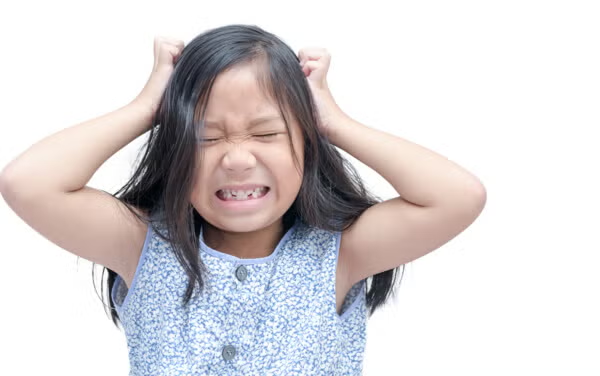
How to treat head lice

A case of lice does not reflect a lack of cleanliness or personal hygiene as some would like to think.  Head lice cause itching and discomfort but are not found to transfer dangerous diseases in the United States like lice in other countries. Here are answers to the most common questions about lice:

How can I get infected with lice?

Head lice can be transferred by sharing things like brushes, combs and even hats.  They can transfer from direct head-to-head contact and lice can transfer from pillows and sheets too. But there is no evidence that lice are transferred from pets to humans.

Do head lice jump from person to person?

Head lice don’t have the body type to jump.  They are transferred only by direct contact.

How long do lice live?

Lice can only live 24 hours without a host, but with a host they can live up to 30 days.  Lice reside in pillows and sheets and return to the host for feeding.  Lice, like bed bugs, bite their hosts for blood. Their bites are annoying and itchy but are not dangerous unless they get scratched and infected.

What’s the best way to rid lice from hair?

Some feel that they should treat for lice even when they only suspect that there is an infestation.  There are no shampoos that totally kill head lice and their nits so manual removal is the only solution. Wash hair with a specialized, over-the-counter shampoo, rinse completely and then go through hair with a nit comb.  Remember that the shampoo is extremely strong and toxic so overuse is not recommended.

Two different types of louse combs used when treat of head lice.

How do I remove lice from my home?

Removing lice from your home is an extremely labor intensive project.  All fabric furniture must be completely vacuumed. Pillows and stuffed animals should be put into a garbage bag for 10 days to make sure that any nits that hatch in that time period die, separated froma host. Other items can be put into the dryer for 30 minutes on a high heat.  All sheets, pillows and comforters should be washed and dried on a hot setting. The entire house should be cleaned before treating the infected person.

How do I know if I really have head lice?

Persistent itching can be indication that an infestation exists. Professionals use a magnifying glass or a florescent light although some feel the florescent light highlights hair lint as well as nits and confuses the diagnosis.  Regardless, lice are normally visible with a magnifying glass.

For more green cleaning and green living information, check out Leslie's website.

Preventing food-borne illness at home

Every year, 1 in 6 Americans get sick from food-borne illnesses. These illnesses, also called food poisoning, also send about 128,000 people to the hospital, resulting in about 3,000 deaths nationwide each year.

Bottom line ~ food-borne illness can be more serious than we think.

Causes of food poisoning are mostly microorganisms, like viruses or bacteria. And although many of these microorganisms cannot be seen, smelled, or tasted, they can cause an illness that ranges from mild to life-threatening.

Food-borne illnesses are mostly picked up in areas where food is prepared as well as eaten, such as restaurants, schools and even our homes. Food-borne illnesses can also be acquired from contaminated drinking water, and water found in swimming pools. Microorganisms can even be passed from person to person, which is why proper hand washing is extremely important!!!

Food-borne illnesses can have a variety of symptoms, but the most common symptoms are nausea, vomiting, abdominal cramps, and diarrhea. Always check with your doctor if you are experiencing any of these symptoms.

To keep your kitchen clean, and those pesky unwanted microorganisms at bay, follow these great tips:

Wash hands properly and often. If your hands are not clean, chances are you're spreading bacteria and virus germs all over your food, your utensils, the kitchen counter tops, and even your family!

To properly wash your hands, scrub your hands with soap and warm water for twenty seconds, making sure to get under the nails and in between the fingers.

When preparing to cook, pre-clean your work area with an all-purpose cleaner. THEN, spray disinfectant on the surface, letting the disinfectant soak for a few minutes. After about five minutes, wipe the surfaces with a microfiber cloth. (For cutting boards, use natural anti-microbials like lemon juice, white vinegar or tea tree oil.) It's very important that you clean the surface before disinfecting it.

After each use, wash all surfaces, including kitchen counter tops, cutting boards, and even utensils. Be sure to use warm to hot soapy water. Don’t forget to wipe down other surfaces and areas that have been touched in the kitchen, such as drink dispensers on the fridge door, light switches, spatulas, and all handles, controls and faucets.

Wash all fruits and vegetables, before and after peeling them.

Do your best to separate raw meat, eggs, seafood, and poultry from the rest of your foods in the fridge. When cooking or preparing meals, always use separate utensils, plates, and especially cutting boards for all uncooked produce and uncooked meat, seafood, eggs and poultry.

Learn to love your thermometer! When cooking foods, it is important to cook food to the proper temperature, and for the proper amount of time. This way, the food is heated up enough to kill the harmful viruses and bacteria that could potentially cause illness. Use a food thermometer be sure when food has reached its safe minimum cooking temperature. For example, when cooking, all poultry should be cooked to a temperature of 165 degrees Fahrenheit, and 160 degrees Fahrenheit for ground meats. Microwave foods thoroughly to 165 degrees Fahrenheit.

At meal times, when food is being served and eaten, keep the food hot, at about 140 degrees Fahrenheit or greater.

After meals, refrigerate leftover food quickly. Illness-causing bacteria and viruses can grow in many foods within two hours unless you refrigerate them. During the hot summer weather, it only takes one hour for illness-causing bacteria and viruses to grow in foods.

Make sure you marinate or thaw foods in the fridge and not in the kitchen sink or on the kitchen counter.

Refrigerate all perishable products as soon as possible after grocery shopping. Learn the “two-hour rule,” which states that perishable foods should not be left at room temperature longer than two hours. Harmful bacteria have the tendency to multiply in the danger zone, which is between 40 and 140 degrees Fahrenheit. When temperatures are above 90° F, as they often are in cars that have been parked in the sun, modify that rule to one hour.

If you are traveling over one hour with groceries in your car, use an ice chest or cooler to keep frozen and perishable foods cold.

Where the weather is warm and the air conditioner is being used in the car, keep your groceries in the passenger compartment, not the trunk.

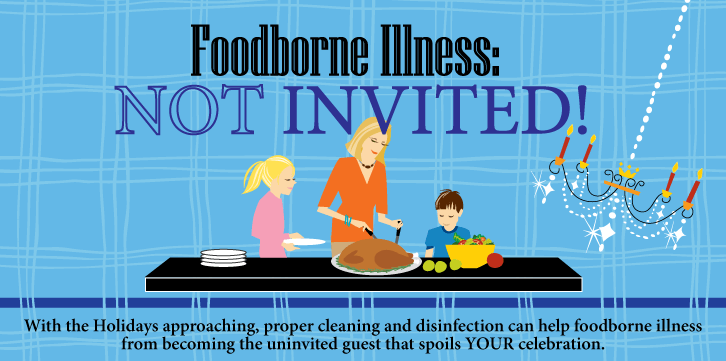
With the holidays approaching, proper cleaning and disinfection can help food-borne illness from becoming the uninvited guest that spoils your celebration! Educating yourself on how to properly safeguard your home and family against food-borne illnesses is one of the best things you can do to prevent any food-borne illness from taking over!

Show this blog and infographic to your family - where food-borne illness is concerned, knowledge is power!

food-borne-illness