Tag: cleaning tips

How to choose the best vacuum cleaner for YOUR home

Someone I know has another friend who recently told my friend that she purchased the perfect vacuum and that my friend should buy one too.  Maybe it's happened to you too. Before we even think about the type of floors our friend might have, we look up that vacuum up on the internet.  But since none of us have the same home it doesn't make sense that we consider a vacuum for ourselves that is perfect for someone else.  Whether you realize it or not a vacuum is a very important appliance for your home. It deserves some thought and research before you buy it. Here are a few tips to help you chose the best vacuum cleaner for your home.

choose-the-right-vacuum-rugs

What type of vacuum cleaner do you want

Different personalities like different types of vacuums.  Upright people are pushy – meaning they like to push things around. They don’t like the idea of dragging something around behind them. Canister people don’t like the weight of an upright and prefer to just handle the pipe and hose. They don’t mind something following behind them. Decide which type of vacuum you prefer and shop for that style of vacuum.

choose-the-right-vacuum-canister

Is weight an issue

If you have a bad back or shoulder issues, don’t even consider a heavier vacuum.  But remember that the weight of the vacuum is directly related to the vacuum’s suction. Light weight vacuums are easy to use but don’t have very big motors. Heavier vacuums have large motors and great suction, but will be difficult for you to use. Decide whether you prefer a light weight vacuum or one that has great suction. Unfortunately, you can’t have both. At least not in the same unit.

choose-the-right-vacuum-for-hardwoods

The best way to clean hardwood floors

For hard wood floors, you might consider a canister vacuum. The soft floor brush that comes with a canister is the absolute best way to clean a hardwood floor. You won’t even need to use a dry mop after using this type of attachment. The bristles of the floor brush work incredibly well at picking up dirt and hair and will leave the floor looking perfect.

If you have allergies

Everyone loves the convenience and cost savings of a bagless vacuum cleaner, but think twice about purchasing one if you have dust allergies. Dumping the dirt container exposes you to concentrated amounts of allergens and dust mites.  You would need to use a mask and gloves to avoid being exposed to all those allergens. Another little known fact about bagless vacuums is that the filters need to be replaced every 6 to 12 months to keep them working efficiently.  This can cost up to $60 for each filter change, depending on the model of the vacuum. These costs are an important consider when you chose the right vacuum.

If you have pets

If you have pet hair, you need to have a very aggressive beater bar in your powerhead. Look for very stiff bristles on the beater bar along with incredible suction power to suck up the hair and dander in your carpet.

Stairs

The right vacuum for stairs should have a hose attachment that can reach at least ¾ of the way up a staircase. You don’t want to be fighting with a heavy, cumbersome vacuum while cleaning your stairs.

Reach

Manufacturers call this a “cleaning radius”. A canister vacuum can clean up to 35 feet from the plug in the wall. A vacuum’s cleaning radius should be something to consider before making your purchase. The information should be listed in the manufacturers details of the vacuum.  Nothing is more frustrating than finding your new vacuum won’t reach where you need it to clean.

HEPA filtration

If you deal with allergies, you want to choose a vacuum with a HEPA (High Efficiency Particulate Arrestance) filter.  You especially want a HEPA rated vacuum if you or a family member has severe dust allergies. The best HEPA vacuum has a sealed system meaning that there are no leaks in the entire system.  Watch out for the labels HEPA-type or HEPA-like.  These are vague ratings and don’t actually mean the vacuum is rated HEPA.  A real HEPA filter removes allergens down to .03 microns. The technical specifications on the vacuum will tell you the filter’s efficiency.

Research the repair records

Some manufacturers don’t even supply repair parts for their appliances. Do a little research on the different models you are considering. You don’t want to have to purchase a new vacuum just because of a minor (but un-doable) repair on your old one.

Your vacuum is an investment

Choose the right vacuum for your home. People spend more on a week’s groceries than they do on their vacuum cleaner. Yet they get frustrated when it doesn’t work correctly. There are quality vacuums on the market that will last decades for a small investment. These models are worth the extra money. You may save a few dollars with a disposable model, but over the years you will save hundreds of dollars by purchasing a good quality vacuum. And, your home will also be cleaner and your health better protected.


Leslie Reichert is a cleaning expert that uses her sparkling personality, great sense of humor and contagious passion to encourage her fans and followers to think differently about what they are using in their homes. Leslie is known as a Green Cleaning Coach and she is changing the world - "one spray bottle at a time".  She is a national lecturer, a frequent homekeeping expert on The Dr. Oz Show, Martha Stewart Living Radio, Maid Brigade’s DIY Cleaning Expert and author of the book: The Joy Of Green Cleaning- a handbook for DIY cleaners. She works with Better Homes and Gardens, Real Simple, Today.com and other national publications.  You can see more of her work at www.greencleaningcoach.com

How to Clean Books and Bookcases

Deep-clean-books-and-bookcases

Warmer temperatures this winter have brought pollen out sooner than expected. May is Asthma and Allergy Awareness month, but if you or someone in your household is suffering asthma or allergy attacks, it’s probably time to do a deep cleaning targeted at removing the allergens than trigger these attacks. Pollen, dust, dust mites and pet dander are some of the main culprits and they are lodged in your carpets, upholstery, drapes, bedding and stuffed animals.

One often overlooked area to address is books and bookcases. Triggers that build up here can really be a problem for an asthma or allergy sufferer. But with the right deep cleaning tips you can alleviate suffering from asthma and allergy attacks. Here is the proper way to clean books and book shelves:

Quarterly cleaning your books and bookcases

This process should be followed every three months to keep asthma and allergy attacks at bay. For more information on cleaning for asthma and allergy sufferers, view this infographic.

Cover the floor. Start by placing a towel on the floor in front of the bookcase to catch any falling dust. Place another towel nearby – you will be placing the books on this one when you remove them from the shelf.

Work top to bottom. Start with the very top of the bookcase and completely remove the dust using a lightly dampened, large looped microfiber cloth folded into quarters (this makes 8 clean surfaces).  Then proceed in the following manner with each bookshelf, starting at the top and finishing with the bottom one.

Clear and clean. Remove all the books from the top shelf and place them on the book towel. Remove all the dust from this shelf, including all five shelf surfaces.

Dust all six sides. Using a fresh, clean surface on your cloth, dust the tops, sides and bottoms of the pages of each book while closed, as well as the front and back covers and the spine. It doesn’t really matter what order you do it in, just that you follow that order with each book, so that you won’t forget any surface on any book. Return each one to the shelf as you finish it.

how-to-dust-a-book

Repeat.  When the top shelf is completely dust-free, remove the books from the second shelf. Dust all the surfaces of the shelf.

Before you start dusting the books, change to a fresh, clean surface on your cloth.

Continue in this manner, changing the microfiber surface when you are dusting the books, not the shelf so that the cloth is as clean as possible when contacting the books.

Once you are done, place the book towel over the other towel and fold them together to prevent dust from falling off the towels. Place them in the washing machine to launder with other soiled items.

While you are cleaning the books, check for damage.

Caring for books

If you notice marks on the covers as you are dusting them, set them aside for extra care. We recommend Absorene Paper and Book Cleaner. It works like a pencil eraser to gently remove marks and stains.

If any books smell a little musty, place them and an open box of baking soda in a plastic container with a lid for at least two days and up to a week if necessary to let the baking soda absorb the odors.

Books last longer when they are stored in the “sleeping position” which is flat. They can be stored in an upright position like you see in a library as long as they are pressed together firmly. Never store your books leaning against another book.

If you don’t have enough books to keep them tucked together tightly, buy some inexpensive book ends to hold them.  If you don’t have bookends, place a stack of books in the sleeping position and use that as your bookends. This will give your books a pleasant looking arrangement.

Organizing and purging books

While you have your books off the shelves, it’s a good time to do some organizing and purging as well. As you work, set aside books that no longer interest you to give them to someone who will appreciate them. Donate your books to your local library or other charity.


Leslie Reichert is a cleaning expert that uses her sparkling personality, great sense of humor and contagious passion to encourage her fans and followers to think differently about what they are using in their homes. Leslie is known as a Green Cleaning Coach and she is changing the world - "one spray bottle at a time".  She is a national lecturer, a frequent homekeeping expert on The Dr. Oz Show, Martha Stewart Living Radio, Maid Brigade’s DIY Cleaning Expert and author of the book: The Joy Of Green Cleaning- a handbook for DIY cleaners. She works with Better Homes and Gardens, Real Simple, Today.com and other national publications.  You can see more of her work at www.greencleaningcoach.com


How to clean pots and pans

how-to-clean-pots-and-pans

Unless you’re an over achiever in the cleaning department, it’s a safe bet your pots and pans need some attention. It’s really not your fault if they have black burnt spots on their bottoms – the heat on your cook top gets so hot that even water can leave a burn mark.  According to the 2017 Cleaning Calendar & Checklists Maid Brigade recommends special attention for pots and pans every three months.  But finding the time to clean your pots and pans is not always easy. That’s why it’s important to make sure you’re using the best methods so you don’t waste time.

Cast Iron

The beautiful thing about cast iron is that you can never really tell how dirty or stained it is. Cast iron has been around since the 5th century BC but cast iron cookware was developed by two American companies in the late 1800’s. The Lodge Company is still manufacturing their cast iron line today. Caring for cast iron is more about keeping the pan oiled than it is about removing stains. Cast iron will oxidize if left open to the air.

how-to-clean-cast-iron-skillet

Never use soap on cast iron as the soap will be absorbed by the pores of the pan leaving a soapy residue in the metal that will leech into your food. Use a steel or stainless scrubby to remove any burnt on food particles, then wipe the cook surface with a paper towel treated with olive oil to seal the pan and prevent oxidation. Clean cast iron every time it's used for cooking.

Store the cast iron in your cupboard and keep a paper towel on the cooking surface to keep the oil from getting on the bottom of your other pots and pans when you stack them.

Stainless Steel

Stainless steel is the choice of professional chefs because of its durability.  Stainless can really stand up to abuse but it does need some special care to keep it looking good. Use this amazing trick from celebrity chefs to help make clean up easier: always heat the pan before putting anything in it. When cold food is put on a room temperature pan, the cold causes the metal to contract and “hold on” to the food, making it stick. However, heating the pan first will cause the steel to expand instead, preventing food from sticking when it is added to the pan, working just as well as a non-stick pan.  After cooking, let the pan air cool and wash it in warm water with a gentle soap.

how-to-clean-stainless-steel-pots-and-pans

Don’t use anything harsh on the outside of the pan as it will scratch. Use a non-abrasive cleaner on the bottom to remove burnt on stains.

Water spots on stainless's shiny exterior are caused by minerals in the water. Remove them easily by using a cloth dipped in white vinegar. The acid in the vinegar will cut right though the mineral deposits that come from the dried water droplets.

Stainless steel can get rainbow-colored stains caused by over-heating. When this happens you will see a rainbow colored stain on the bottom or sides of the pan.  Remove those stains by rubbing some ketchup over the area and letting it sit for a few minutes before wiping the surface clean with a soft cloth. Clean stainless steel pots and pans this way every three months.

Ceramic

Ceramic bakeware should be treated with care. Ceramic must be left to cool completely before placing in water for washing.  Once the ceramic dish is cool, use hot water and baking soda to remove food that may be stuck to the cooking surface. Then, just wash ceramic bakeware in in warm soapy water. Clean ceramic dishes every time they're used, because baked on food will be harder to remove with each subsequent heating.

how-to-clean-ceramic-bakeware

Forged Steel

Forged steel cookware can be treated like cast iron even though it’s not as heavy or as porous as cast iron. The oils on the forged steel keep food from sticking. Scrubbing too hard will remove those oils, so don’t be too aggressive with the cooking surface. Simply keep it clean by washing it in warm water and a touch of gentle soap. Just make sure not to soak forged steel pots or pans in water.

Copper

Most people think copper cookware is extremely hard to care for but this couldn’t be further from the truth. The copper on the outside of the pot creates an excellent conductor for heat while the hard metal inside keeps the food from coming in contact with the copper. Copper pots are usually lined with a hard metal such as nickel, tin or stainless steel.  If using copper pans be sure to check the lining inside frequently, to make sure it’s in perfect condition and not wearing away.

how-to-clean-copper-pots-and-papns

When copper is exposed to air, it turns a lovely patina that can add to the charm of the pot. If you prefer it shiny and clean, use a natural acid like ketchup or vinegar to remove the patina. Do this every three months.

Aluminum

Aluminum pots and pans can be washed in warm soapy water. To remove stains, you can use a cut lemon or sprinkle cream of tartar on the stain and rub it in with a soft cloth. Then just rinse with warm water and dry with a soft cloth.

No matter what type of cookware you have, the real secret to keeping it looking good is to address burn marks and stains as they happen. A simple burn mark may come off easily when it first happens but if it’s not addressed, the pot will get put back on the heat and the burn is seared onto the pot. These stains are almost impossible to remove, so it's important to clean up burn marks and stains every time you use an aluminum pot.


Leslie Reichert is a cleaning expert that encourages people to think differently about their cleaning products. Leslie is known as the Green Cleaning Coach is changing the world - "one spray bottle at a time".  She is a national speaker, a frequent homekeeping expert on Martha Stewart Living Radio, Maid Brigade’s DIY Cleaning Expert and the author of the book: The Joy Of Green Cleaning. For tips and simple, but effective strategies visit her at www.greencleaningcoach.com


How to Clean Glass Light Fixtures, Shelves and More

There are a few things that hardly ever get cleaned in your home, yet when they get forgotten, they make your home look neglected.  To make sure your home looks and feels cared for, take a few extra minutes to clean glass light fixtures and overlooked items at least every three months, or more often if you’ll be entertaining.

Light fixtures

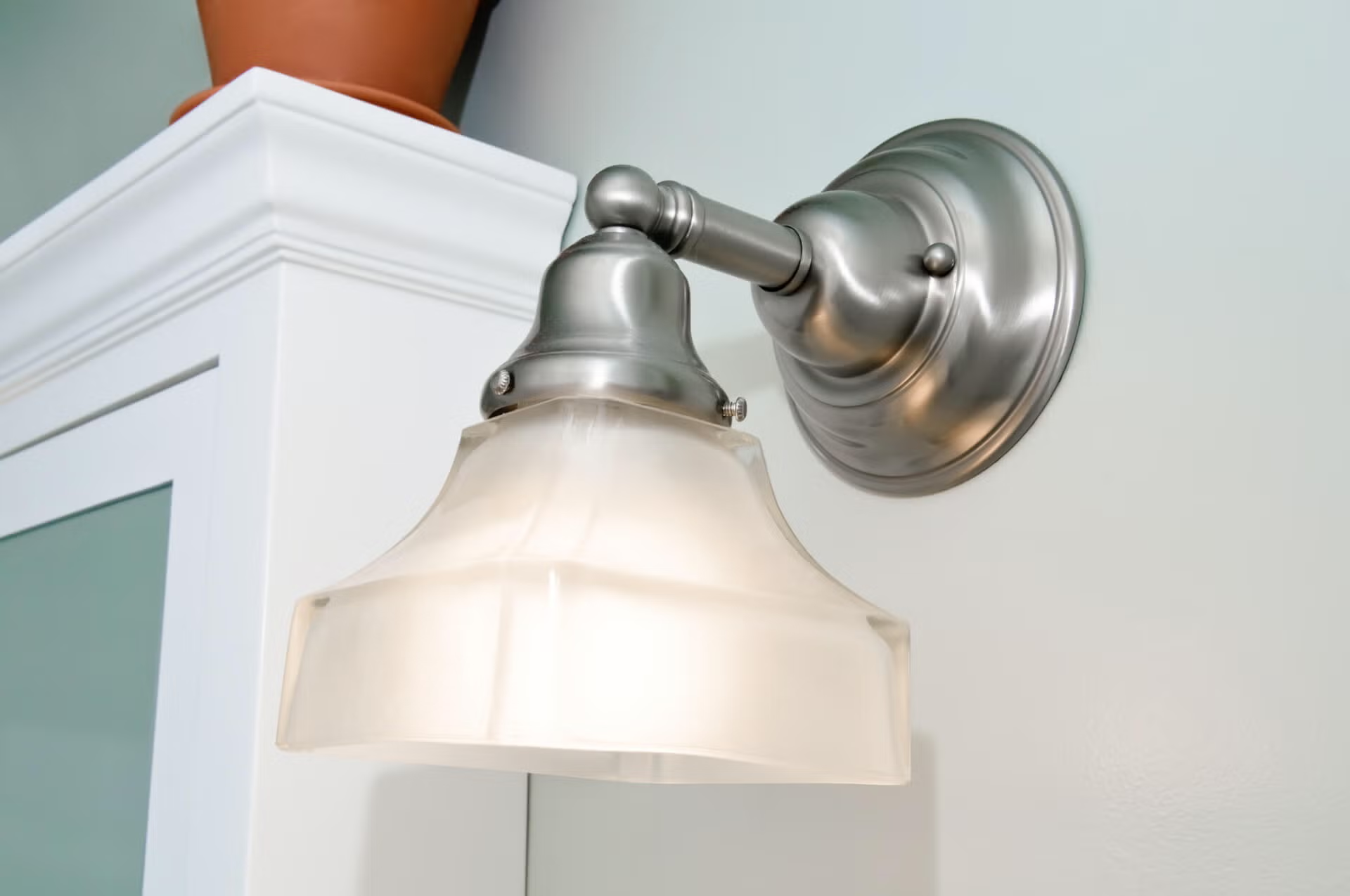
When light fixtures are clean you really don’t notice them, but when they are foggy and filled with cobwebs and dust they definitely let your guests know you’re not paying attention to the little things. The best part about cleaning your light fixtures is that you have an appliance in your home that’s willing to do this job for you – just pop the fixtures in your dishwasher.

how-to-clean-glass-sconce

Wipe any dried on water spots with a damp microfiber cloth. If you can’t take the fixture down from the ceiling, use a microfiber cloth on an extension rod to remove the dust.  Also clean glass globes from chandeliers and sconces in the dishwasher after removing them from the fixture.

Glass shelves

Glass shelving is beautiful inside cabinets and showcases. Even though they’re inside a cabinet they still get dirty. Dust and dirt work their way inside the cabinet and turn those beautiful shelves into a dusty foggy mess. Clean glass shelving by removing the items on the shelf and using a fine woven microfiber cloth designed specifically for glass.

how-to-clean-glass-shelves

Make sure the cloth is damp, not wet. After wiping the cloth over the glass shelf, finish with a dry microfiber cloth which will make the glass look perfect. If It’s been awhile since you’ve cleaned the shelves, you may want to take a minute and wipe the underside of the shelf as well.

Hardware

Door handles and drawer pulls are another often-overlooked item when cleaning the kitchen cabinets, but they’re some of the grimiest places in your home. Hand oils mix with dirt and dust to create a thick residue that can remove the finish on your hardware, so this hardware should get cleaned every three months to prevent damaging buildup.

how-to-clean-cabinet-pulls

Clean the handles and pulls with some soapy water and a gentle cloth to wash away oils and leave the pulls looking like new. For severe buildup, spray some rubbing alcohol onto a microfiber cloth and wipe them down to break up the grease and grime.  Then finish by washing with warm soapy water, a cleansing rinse and towel dry.

Fan blades

Have you ever leaned back to relax in your recliner only to notice a huge amount of dust on the blades of your ceiling fan? Ceiling fans collect dust whether they are moving or not.  People think that turning on a fan will remove the dust. Not so. Even a moving fan paddle collects dust on the front edge of the paddle. A quick trick to removing the dust from a ceiling fan is to use a pillow case. Put the open end of the case over the fan paddle. Hold the pillow case against the paddle and pull it off. The dust on the top and sides of the fan paddle will come off inside the pillow case to avoid getting dust all over the room. Then simply take the dusty pillowcase to the wash.


About Leslie

Leslie Reichert is a cleaning expert that uses her sparkling personality, great sense of humor and contagious passion to encourage her fans and followers to think differently about what they are using in their homes. Leslie is known as a Green Cleaning Coach and she is changing the world - "one spray bottle at a time".  She is a national lecturer, a frequent homekeeping expert on The Dr. Oz Show, Martha Stewart Living Radio, Maid Brigade’s DIY Cleaning Expert and author of the book: The Joy Of Green Cleaning. She works with Better Homes and Gardens, Real Simple, Today.com and other national publications.  You can find her at www.greencleaningcoach.com
Microfiber for cleaning - what's the big deal?

microfiber-cleaning-cloth

For the past twenty years I've been sharing the incredible value of microfiber for cleaning. But there are still people who don’t know about this “miracle” for their household cleaning, and if you're one, keep reading.  Microfiber can clean any surface with just water and leave it free from dirt, grease, smears, streaks or lint. It’s a great option when you are trying to take the toxins out of your cleaning.

What is microfiber

By definition microfiber is any thread that is smaller than 10 microns (about 1/5 the thickness of a human hair).  Microfiber that is designed for cleaning is a thread that has been split or cut with a machine so that it has numerous cleaning surfaces. That makes it very absorbent, with the capability to hold from five to seven times its own weight in liquid.

There are various grades and price points for microfiber products. Some are overpriced but overall you do get what you pay for. Seek out mid to high quality cloths – you won’t regret it. Because it’s made from polyester or a polyester blend, it offers longer lasting, higher durability, and greater efficacy than traditional cleaning cloths.

History 

Microfiber is not just for cleaning. Originally, microfiber was manufactured by the Japanese for swimsuit material. Microfiber clings well to the body so the swimsuits looked great. But it was found to be very absorbent and not a good choice for swimwear.

microfiber-not-just-for-cleaning

Scientists in Sweden took the absorbent fabric and started manufacturing microfiber cloths for commercial use. Starting in the early 1990’s, Europeans started marketing microfiber as a new way to clean.

Uses

There are now many other uses for microfiber other than cleaning. Car detailers have been using microfiber cloths for years because of their lint-free properties. Furniture manufacturers use the fabric because it can be cleaned with just a damp cloth. Even the NBA uses microfiber basketballs designed by Spalding, because it doesn’t need the break in period that a leather basketball needs.

Disinfecting properties

Independent studies have found that microfiber does an excellent job of disinfection without the need for chemicals. This is very important if you have children, pets, elderly family members or those with asthma/allergy problems or compromised immune systems living at home because these groups are particularly vulnerable to the many ingredients in traditional cleaning products containing toxins.

Microfiber disinfects by going underneath the bacteria and lifting it off the surface. All those teeny tiny cleaning surfaces hold onto the bacteria until you place it into the wash. The combination of hot water and laundry soap releases the bacteria into the water so it can be washed away with the waste water.

With microfiber you don’t need to use harsh chemicals to make a surface free from bacteria.  So it’s a totally opposite technique to our current ways of disinfecting, which includes lots of chemicals and a two-step (clean first, then disinfect) process.

There’s really no reason not to look at microfiber for cleaning – it cleans better, faster and with fewer chemicals plus it last longer than other options.

microfiber-for-cleaning

How to use

Microfiber is so easy to use. Just wet the cloth with water, wring it out really well and start wiping dirty or germy surfaces. Then, for perfection on a particular surface, dry the area with a dry microfiber cloth. This combination will leave the surface immaculate.  To get the most out of each cloth during cleaning, fold each cloth in half and then fold it in half again. This gives you eight cleaning surfaces to use. After wiping an area, switch to another clean area of the cloth so you are using a clean side each time.

To prevent cross contamination on germy surfaces, use a color-coded system. For example, the pros at Maid Brigade use only red cloths in the bathroom (think, “code red”), only yellow in the kitchen (think, “yellow”), blue for mirrors and glass (most have a blue hue) and green for dusting and general cleaning (G = general). This method eliminates the chance that germs will be spread from room to room.

Microfiber-for-cleaning

How to care for microfiber

High quality microfiber can be washed with hot water and laundry SOAP (detergent builds up on fabric and will leave a film in the cloth).  High quality microfiber cloths can be dried in the dryer on warm heat. Dryers tend to melt the threads of the lower-grade fabrics, fusing all those microscopic cleaning surfaces together, making the cloth no more effective than a regular rag. If you’re not sure of the quality of your microfiber, just let the cloth air dry. Never use dryer sheets as the oil in the sheets will accumulate in the threads of the fabric and compromise its cleaning ability. You also want to wash your microfiber cloths separately, because lint and other fibers will get trapped in those cleaning surfaces, clogging them and ruining their performance.

For more about microfiber, click here.

Control clutter and control your health.

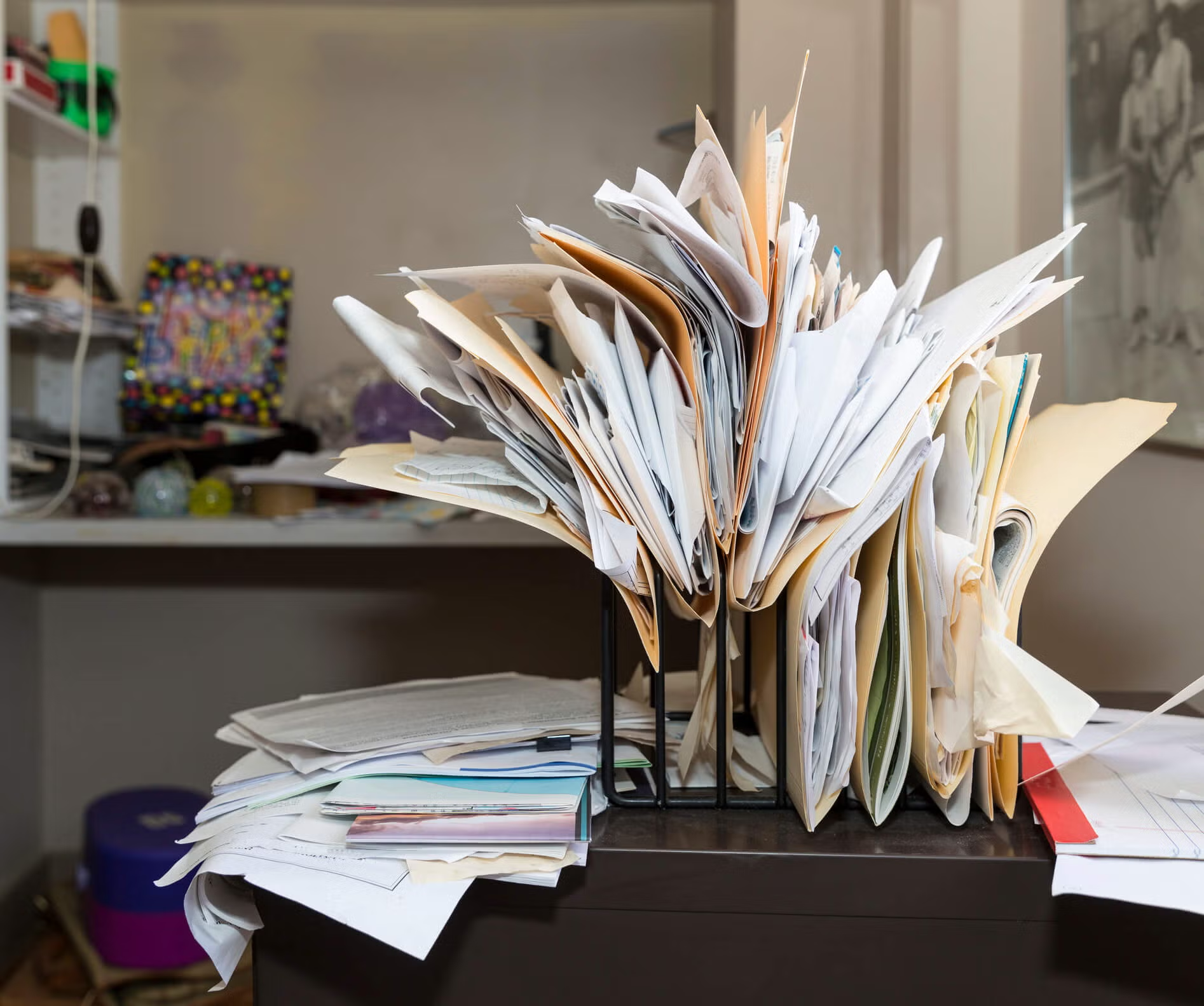
clutter-control-on-the-desk

If your overstuffed closet, packed garage, littered desk or messy basement brings on feelings of stress – even suffocation – don’t worry, you’re not alone.  Clutter, to varying degrees, brings distress to many of us.  For some, clutter can feel “crushing,” almost to the point of no return, like it has taken over our lives. Even if our clutter is stacked up in neat piles, when it’s all over our homes and our lives it can be damaging to our physical and mental health.

Physical effects of clutter.

Concerning our physical health, clutter by itself has an overwhelming presence, enough to cause unwanted and unneeded stress.  But clutter also creates a haven for germs, giving them a home to live, breathe, and grow.  For those who suffer from allergies, clutter can aggravate allergens by causing a buildup of mold, dust mites, cockroaches, dander, and at times, pesticides and toxic chemicals and fragrances.  Clutter adds to the stress of not being able to find things when you need them.  It also increases the risk of trip-and-fall injury and can cause fire hazards.

Psychological effects of clutter.

Clutter affects our mental health by increasing our stress and anxiety levels.  It can put added pressure on us and make us feel overwhelmed, and sometimes even depressed.  Mentally, clutter can weaken our decision-making skills, while strengthening our procrastination.  Clutter can teach us to avoid large tasks instead of organizing and tackling them.  This avoidance can prevent us from living now and moving forward with positive energy and a positive outlook.  Sadly, clutter can make mental issues worse.  Sometimes feeling so mentally cluttered can hold you back from doing the things in life you want to do.

control-clutter-in-your-home

Controlling clutter can have a positive effect on our lives.  The more we can control clutter, the better we are able to take care of ourselves mentally and physically.

How do we gain control over clutter?  By fixing the core of the problem first, which usually starts with our behavior.

Why do we clutter?  Is it due to lack of time or lack of organizational skills?  Do we suffer from an underlying health issue, or what doctor’s call chronic disorganization?  Does the disorganization of clutter stem from chronic pain, depression, grief, or ADHD?  We can better understand what’s causing us to clutter if we look at the nature of our clutter – is it things we won’t need long term, or things we might need long term? Examining this will help determine the best course to fix the problem.

Maybe our clutter is more than just a pile of stuff, but serves as a security blanket, filling multiple needs.  After all, clutter can falsely be viewed as providing a sense of security, an indication of self-worth, comfort, a path to the past, a feeling of being loved, or a variety of items we promised to do, but never got around to.

No matter why we do it, we can stop it, and move towards enhancing our physical health, mental well-being and overall quality of life.  Reducing the accumulation of clutter is a two-part process, beginning with elimination of clutter, and continuing with an ongoing, life-altering organizational system that halts clutter before it builds up.

control-clutter-forever

Here are five quick cleaning tips to keep your clutter-free life intact:

Think “bite size”. Organizing clutter can get a tad overwhelming so plan to organize only fifteen minutes a day.  It’s too easy to procrastinate when the other choice is a full day of organizing! To make it productive, make a plan. Designate a day for each room or each task (file papers on Mondays, for example) and have sorting baskets or boxes close at hand. You can sort items by level or room to which they be returned, by trash/recycle/give-away, or any other categories that work for you. When the fifteen minutes is up, return the contents of each basket to its proper spot in your house.

Use available tools. If your clutter seems to be taking over your work space, you may not be as productive as you would like.  Keep your main work area functional.  It’s easy to find affordable, functional desk and drawer organizers or dividers online and in stores to help control clutter. Figure out a storage system that works for the kinds of things you need to store in your work space – think through your needs. Make a plan – have a set time that you block off a few times a week to re-boot your work area. When you find a plan that works, you’ll stick with it. (Check out Organizing U’s blog on drawer organizers here.)

Limit daily distractions. Artificial interruptions derail us from following through with putting things away when we’re through using them to control clutter. Like email. Instead of checking email throughout the day, dedicate time twice a day for it. In truth, the times we HAVE to be glued to our email Inboxes are fewer than we perceive.  But when you are checking emails, follow through here too. Respond to emails right after reading them so you won’t have to worry about it later.

Touch it once. Avoid stacking (and re-stacking) papers at home or at work.  File them away in the proper areas as soon as they are completed. As old-fashioned as it sounds, In/Out boxes keep pending documents tidy yet close at hand.

Purge often. Throw our expired foods, medications, vitamins, etc.  Go through junk mail, tidy up counter tops, empty trash bins, etc.  Organize and tidy for a few minutes each day. Every square foot of clutter eliminated is an improvement in your mental and physical well-being. With minimal effort daily, you can thoroughly organize every square foot of your home about once a quarter. Control clutter and keep life simple and stress-free!

To read more on clutter control and home organizing, check out these blogs:

17 Tips to keep your resolution to get organized in 2017!

3 simple steps to organize the junk drawer

Is your home a tad stinky? Use these odor control tips.

Is your home smelling a little stinky?  This usually happens during the winter. We close up our homes in October and don’t open them up again until April. That means we’re living with the same air for six months. If you’re smelling some unusual odors in your home, read on for a plan to help you control odors in your home and freshen up:

Garbage Cans

Clean the inside of the trash can by washing it with hot soapy water. Then deodorize it with distilled white vinegar mixed with an essential oil.

clean-trash-can

You can make a "garbage sachet" to place at the bottom of the pail beneath your trash bag: place some fresh coffee grounds and whole cloves in a clean coffee filter, and tie it closed using string, a twist-tie or a rubber band. Simple!

Refrigerator

Don't just remove rotten food, but also clean the shelves and drawers to remove any rotten liquid. When things rot in a refrigerator, they tend to leak and leave a terrible smelling fluid. Clean and disinfect that area using distilled white vinegar or hydrogen peroxide and a microfiber cloth. Or remove the shelves and wash them in the kitchen sink with hot soapy water.

Pet Smells

Smells from your pets can be removed with consistent cleaning. You should vacuum two to three times a week to remove pet hair, fur and dander.

control-pet-odor

Pet beds should be washable or have removable covers - launder every week. Keeping your pet groomed will also help control pet odors in the home.

Cooking Odors

Control cooking odors with a DIY air purifier. Combine 2 cups of water, some baking soda and a few lemon peels in a pot and heat the mixture on your stove. The aroma will work to remove those stinky smells.

Bathroom

Areas around the toilet can have what I call "little boy syndrome" where the urine sprays out of the toilet and embeds into the walls, woodwork and flooring. Regular cleaning with a good cleaner AND a disinfectant will work to control those odors.

Clean-odors-around-the-toilet

The inside of the toilet also needs to be cleaned well. You can use a simple mixture of salt, baking soda and borax to make a toilet bowl cleaner that will clean and remove smells. If you have a toilet bowl that has stains - use a pumice stone to remove those stains.

Carpeting

Carpets hold smells like a sponge. Fill a spray bottle with bottom-shelf vodka and spray that over smelly areas. When the alcohol evaporates it carries the smells away with it! This tip will also control odors on smelly fabric furniture.  If the carpet and furniture are really bad you should spend the extra money and hire a professional to steam clean them.

Garbage Disposal

Your garbage disposal can be the cause of a stinky sink.

clean-the-garbage-disposal

To correct that, clean the garbage disposal by grinding a mixture of ice cube, salt and frozen lemon peels. Let it run for a few minutes, then flush with boiling water. Fresh!

Bed Linens

Launder bedding weekly. In nice weather hang everything outside to dry, where the sun and fresh air create ozone that helps remove stale odors from pillows and quilts.

Closets

Stinky shoes can really make your closets smell terrible. Control odor in your shoes by spraying some newspaper with distilled white vinegar then crinkling it up and placing it inside your shoes.

control-odors-in-the-closet

If you don't want to use newspapers, you can spray the inside of your shoes with rubbing alcohol or vodka. Add a few drops of an essential oil into the alcohol or vodka to help cancel out the alcohol odor.

Stale Odors in Rooms

General bad smells can be removed by spraying door jambs with vinegar and your favorite essential oil. By spraying the jams of all the doorways you will get a clean fresh smell when entering into the room!

Workout Clothing

Exercise clothes retain sweat smells and are extremely difficult to remove.  There are some new laundry soaps that work great to remove these smells. Borax or baking soda are great additives to the laundry to get rid of smells too. Just add a tablespoon to your regular laundry soap.

Repeat these tricks to control odors in your home year-round, but especially in the winter. Happy cleaning!

Week 2 of the Holiday Cleaning Countdown

20-Day Challenge: Week 2

The Dining Room

holiday-cleaning-countdown-20-day-challenge

(Scroll to the bottom for links to other blogs in this Countdown Series, including a printable checklist.)

The focus for our Holiday Cleaning Countdown is the three rooms you’ll use most when entertaining during the holidays. And this week the focus is the dining room. With one task per day, you’ll spend 7 days on this room, but once completed it will stay fairly clean until the holidays. A quick touch-up is all you’ll need before guests arrive – do this when you place your floral centerpiece to whisk away any petals, berries or needles that stray from the holiday arrangement.

This week our holiday cleaning checklist calls primarily on one tool to get this room ready: microfiber. So gather all your microfiber cloths and mop heads along with your microfiber mop.  Microfiber lets you deep clean quickly, without harsh chemicals or any mess.

Below are all the tasks for Week 2 of the Holiday Cleaning Countdown:

DAY 7: Walls - Start by removing the dust and cobwebs from your walls. But instead of washing them like our mothers used to, use the microfiber mop and a spray bottle of water to do the same job.  Start with a clean, large looped microfiber mop head and a spray bottle of plain clean water. Spritz the mop head so that it just has a light film of water on it. Start at the baseboard of the wall and by using a Z pattern, work your way up to the ceiling. Work one vertical section at a time, always starting at the baseboard and working up. The damp microfiber mop head will catch and remove dust and dirt that was on the wall.  This process will also catch cobwebs that may be hard to see with the naked eye.  If your walls are extremely dirty, change the mop head often!  Also change the mop head when it gets too damp.

holiday-cleaning-tip-chandeliers

DAY 8; Light Fixtures - When cleaning your light fixtures, let your dishwasher to help! Place then glass globes on the top shelf of your dishwasher and wash them with a normal cycle. Then, give them a touchup with a blue fine woven microfiber cloth when they come out, just to remove any spots or drips. Hand wash smaller glass pieces with dishwashing liquid. Dry with a microfiber cloth.

DAY 9: Dusting - When dusting the furniture use a fresh, lightly dampened microfiber cloth. Normally, water is all you’ll need on the cloth. But, if your furniture is looking a little drab or cloudy, you may want to use a polishing mixture of 1 tbs. mayonnaise and 1 tbs. olive oil.  Mix these two ingredients together and apply a light coating on the flat surfaces of your furniture. Let it sit for a minute then buff off with a dry microfiber cloth. Check out our video:

DAY 10: Serving Pieces - Use your dishwasher to clean all the dishes and serving pieces you expect to use during the holidays. This ensures everything will be clean and dust free before serving your guests.  Be sure to include your crystal and silver. If you silver is tarnished, set it aside for DAY 12.

DAY 11: Linens - Make sure to launder and iron the tablecloths and napkins you plan to use for your holiday event.  Check for spots and stains on each piece. Use some hydrogen peroxide to remove dark spots and rubbing alcohol for greasy stains.  Air dry the treated cloth in the washing machine. If the stain has not disappeared repeat the treatment, then launder. If the stain persists, invest in a new tablecloth or set of napkins.

holiday-cleaning-tip-silverware

DAY 12: Silver – Safely polish tarnished silver with some old-fashioned paste toothpaste and a soft cloth.  If you’re pressed for time try placing your silverware in a deep dish lined with aluminum foil.  Fill the dish with distilled white vinegar then place the silver on the foil. The tarnish will “jump” off the silver and onto the foil. The, wash the silver as you normally would. It’s not as effective as polishing but you’ll notice a difference.

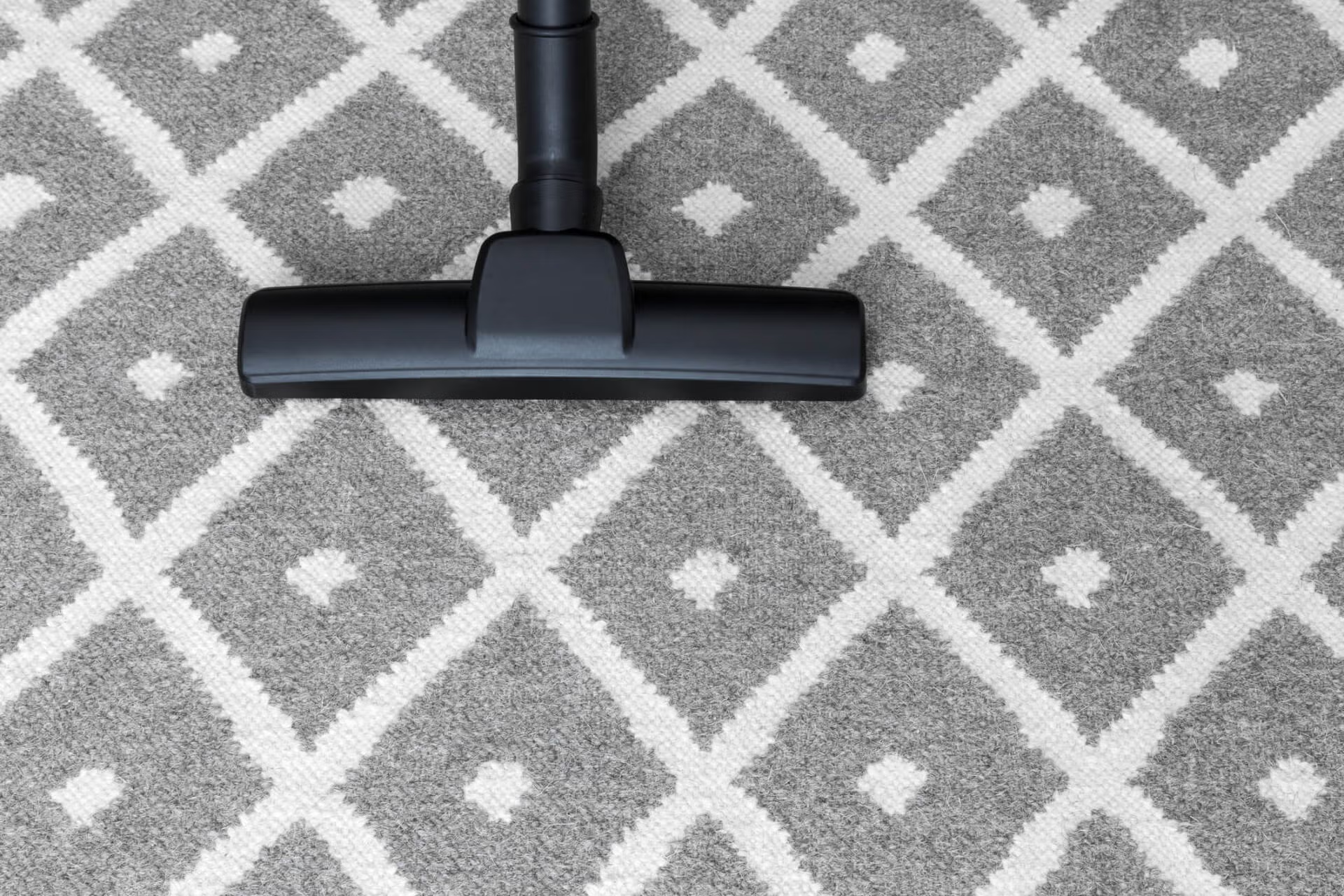
DAY 13: Floors – Your final task on this week’s holiday cleaning checklist is to vacuum rugs and vacuum or wash hard wood floors so they look ready for your company. Make sure your baseboards are wiped clean and are dust free.  Spot clean the woodwork as needed. Once the floors are clean, you can keep touching them up during your weekly cleaning.

holiday-cleaning-tips-linens

And now there’s just seven days left in the Holiday Cleaning Countdown, and seven days before you can celebrate the wonder of the holidays and rejoice with your guests.

Check back next week for a detailed description of the Week 3 tasks!

If you missed our other posts in the Holiday Cleaning Countdown series, please click on these links:

https://maidbrigade.com/blog/holiday-clean-up-20-day-challenge
https://maidbrigade.com/blog/20-day-challenge-holiday-clean-up-day-1

20-Day Challenge: Holiday Clean Up - DAY 1

holiday-clean-up-guest bedroom

To help prepare you for the holidays, we've collected some expert advice from our guest bloggers to share throughout December. Be sure to check out our 20 Day Challenge on holiday cleaning and getting your home ready for the holidays. If you plan to host overnight guests, we recommend you download the Holiday Clean-Up 20-Day Challenge PDF guide below, because the first 6 days focus on the Guest Room. READ ON, for cleaning tips and details on preparing the most critical part of this room, the guest bed.

holiday-clean-up-20-day-challenge

Day 1: Strip and wash the sheets. Remake the bed. Use furniture movers to make changing the linens easier.

Our 20 day count down to a clean holiday will start in the guest room. Why start here when so many other areas need attention?  Because the room your guests will pay the most attention to is the room where they sleep. There, they can look around without any inhibitions so it’s really important to get this room extremely clean when making your home ready for guests. The first thing to focus on is the bed.

How to wash your bedding:

Make sure the sheets are clean and stain free. If they look at all worn or off color – spend the extra money and buy a new set.  Nothing looks more inviting than freshly laundered sheets! This includes the pillows and the pillow cases. No one wants to sleep on a pillow that looks or smells like it’s been on the bed for decades. Wash the pillows and remove the stains with my miracle pillow stain remover.  Watch the video below:

How to make your bed:

Make the bed starting with a fitted bottom sheet. Using a flat top sheet, place the pattern facing down so your guests pull down the sheets they’ll see the pattern on both sheets. Use hospital corners to keep everything nice and tight. Place a blanket over the top sheet. Fold down the top sheet about 4” so that the pattern will show and go over top of the blanket.  Top off the bed with a clean, fresh bedspread. Add a down comforter at the end of the bed to give your guests comfort options at night. An easy holiday cleaning tip is to use decorative pillows to make the room look inviting and up to date.  Add a big empty basket near the bed to give decorative pillows a special place during the night. Spray the bedding with witch hazel infused with your favorite essential oils to add safe and inviting fragrance to the room to put the finishing touch on your holiday clean up in the guest room.

Keep watching our blog for more holiday cleaning tips throughout the month!

Holiday Clean Up: 20-Day Challenge

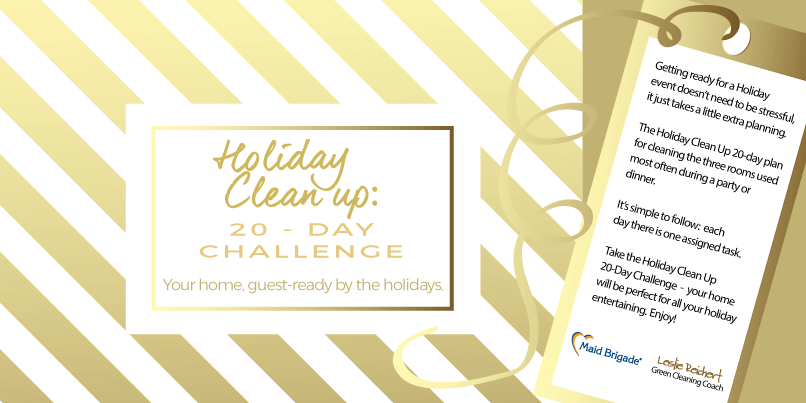
Getting ready for a Holiday event doesn’t need to be stressful, it just takes a little extra planning. The Holiday Clean Up 20-Day Challenge is a step-by-step cleaning guide for the three most visible rooms during a party or dinner.  It’s simple to follow: each day there is one assigned task.  Follow this cleaning guide and, in just 20 days, your home will be perfect for all your holiday entertaining.

Click on the image above to download the Holiday Clean Up 20-Day Challenge cleaning guide.

And, you can access this PDF for a more detailed, text version.

There's also a companion blog, about super-quick short cuts to use when company's coming over last-minute, called Holiday Cleaning Hacks.


Holiday Cleaning Hacks

During the holiday season nothing stresses people out more than cleaning up for guests. Short on time? Use these holiday cleaning “hacks” to get your home ready in a jiffy.

Only clean what’s dirty – As pros we are programmed for thoroughness but with a jiffy clean we are intentionally finding ways to cut corners. When you're in a  hurry, why clean things that aren’t dirty? Instead, spot clean the areas that you can see are dirty like the handles on refrigerators and microwaves. Look around and then clean the areas that look like they need attention.

Use a “tool belt” – You would never see a carpenter going up and down a ladder every time he needed a nail.  Instead he carries everything he needs in a tool belt so he can work more efficiently.  You can use the same system to make your cleaning easier. Gather all your cleaning products, cloths, brushes and other tools you’ll need and place them in a bucket so you can take them from room to room. Or you can find a comfortable apron with pockets and loops so your bottles and rags will be right where you need them.

cleaning-supplies-bucket


Use your vacuum instead of a dry mop – Dry mops do a great job of lifting dirt, but you still have to use a dusting broom and a dustpan to get the dirt off the floor. Remove this step by just using a canister style vacuum with a dusting brush attachment. You’ll be cleaning the same area but removing the step of filling and emptying the dust pan.

Use a feather duster – Instead of polishing your furniture with a polishing spray and cloth, switch to a high quality ostrich feather duster. You can dust every flat surface without moving a thing. A genuine ostrich feather duster will hold onto the dust until you shake it out. Can’t find one? Try a microfiber “feather” duster instead.

feather-duster

Use your appliances – Don’t waste time cleaning something when you can let the dishwasher do the work for you. You can use it to clean items on your bathroom vanity or even the filter over your stove. Your dishwasher can be a very valuable cleaning tool.

Only clean what your guests will see – If you only have a small amount of time to clean, focus only on the areas a guest might see. Leave the upstairs bedrooms for another time. Spend your time on the entry way, hallway, kitchen and the room where you might ask your guests to sit. As far as the other rooms and the upstairs - keep the doors closed. Guests usually won’t open a closed door.

Clean your bathroom in minutes – Start by NOT cleaning the shower.  Use a damp, fine woven microfiber cloth and wipe all the surfaces.  Start with the mirrors, then move down to the vanity area and save the toilet for last.  You don’t even have to dry the areas once you’ve wiped them with a microfiber cloth. They will look perfect when you’re done.

microfiber-cloth

Just swish the toilet bowl– Don’t bother with toilet bowl cleaner when you are quick cleaning. Use the toilet brush and give the inside of the toilet a quick swish.  Then flush and move on.

Use your dishwasher to hide dirty dishes – If you don’t have a dishwasher then you can place a large tub under the sink and place the dirty dishes there until you have time to wash them.

Steam clean your microwave – Place a microwavable bowl filled with water into the microwave. Run it on high for 3-4 minutes. Once it’s done, carefully remove the bowl and wipe the sides of the microwave with a microfiber cloth. Any stuck on food should wipe right off.

Lint rollers and paint brushes – Need to get into tight areas quickly? Keep a lint roller and paintbrush in your tool apron. Lint rollers are great for pet hair on furniture as well as dusting lamp shades. Paint brushes are wonderful for removing dust and dirt tucked into hard to reach areas.

dust-lamp-shade-with-paint-brush

Use natural fragrances to cover up your cleaning problems – Sometimes you just don’t have the time to clean but you can “hide” your dirt behind a nice aroma. But don't use store-bought air fresheners - synthetic fragrances usually contain toxins you don't want in your home.  Instead, make natural fragrances in a jiffy using a few drops of your favorite essential oils mixed into a bottle of witch hazel and spray entryways and door jambs so your guests will smell the lovely fragrance and overlook your cleaning shortcomings.

But let's face it. Some days there is no gas in the tank for anything extra. If you’ve run out of time or motivation to even do the smallest cleanup, just turn down the lights and turn on a few battery operated candles. You’ll be surprised how nice and clean a room looks with minimal lighting and a few candles.

If you have more time for truly sparkling results, check out the new Holiday Clean Up: 20-Day Challenge I created with Maid Brigade. It's a step-by-step plan to deep clean the three most visible rooms during entertaining, with only one or two tasks per day. Keep it on your phone or tablet for a handy reference during the holidays.

8 surprising tricks to reduce allergy attacks this fall

OR, what do a clothes dryer, a pillow case and a hair dryer have in common?

indoor-allergens

When the weather turns colder we close our windows and it seems that everyone starts getting sick. Most of the “sickness” is really a reaction to dust and allergens that are hiding in our homes. Hiding??? Yup, hiding throughout your house. If you or someone else in your house notices more congestion, more sneezing or coughing, this could be your problem.

A really good vacuum with lots of attachments isn’t the only way to reduce these irritants indoors. And besides, it’s big and clunky, puts off heat when operated and it’s all the way down in the basement. Instead, try these surprisingly easy tricks to get rid of allergens in your home – and your sickness.

Fluffy deep pile rugs – Rugs in general are dust magnets but those new designer rugs that have long shaggy pile are the worst. Dust, dust mites, pet dander, pet hair and other allergens get embedded deep within the fibers. Put smaller size rugs right into your clothes dryer to remove the allergens. As you will discover in this blog post, your dryer is possibly your best weapon against allergens in your home. The heat of the dryer kills the dust mites and the air flow frees the allergens and exhausts them outside.

clothes-dryer-best-defense-against-allergens

Throw Pillows – Throw pillows accumulate dust just like your wood furniture. I think I’ll dust them today. Says no one, ever. And you can’t, really, anyway. You can clean them with the upholstery tool on your vacuum OR simply take them outside and give them several good whacks to dislodge dust and other microscopic irritants, then use your trusty dryer to kill and remove the remaining, more deeply embedded allergens.

Book Shelves – Books hardly ever get dusted when we clean. Yes, we dust the shelf they are sitting on, but never the tops of books.  Ever watch a movie and see the dust they blow off when they pull an old book out of a shelf in the library?  It’s exaggerated in the movies, but commonly occurs on a lesser scale in an average home.

micro-fiber-dust-cloth-for-allergens

Books get really dusty. You can quick clean them on the shelf by using a really good feather duster or your vacuum and the upholstery attachment. But if it’s been a while, a deep clean may be in order: pull all the books off the shelf and dust all six sides of each with a microfiber cloth. Microfiber grabs and holds dust and other allergens while other dusting rags just move dust around. If you’ve got allergies, you need microfiber for a really thorough job.

Draperies- Drapes and curtains are the worst place for dust and allergens to accumulate. Most allergists recommend removing window dressings completely when someone has been diagnosed with dust allergies. If you can’t live without draperies or curtains, there are a couple ways to keep the allergens at bay. Vacuum your window treatments on a bi-weekly basis using your vacuum and upholstery tool. Once a month, take them down and place them in the dryer on high heat.  Keep this regimen and you will never need to go through the entire process of washing, drying and pressing your curtains.


Lamp shades – Pleated lamp shades never really get dusted. You may dust the top of the pleats of the shade by “blotting” with a microfiber cloth (you don’t want to push particles into the weave of cloth shades) BUT the real allergens are hiding deep down inside the pleats. Use your vacuum and the upholstery tool to draw dust out of the pleat. Then use a new paint brush and brush down inside the pleats to loosen the dust nestled there.  Finish by vacuuming the entire shade one final time.

dust-lamp-shade-with-paint-brush

Artificial plants and flowers – Allergens LOVE to hide in dry flower arrangements and on artificial plants. Artificial arrangements tend to be overlooked when we are dusting. A simple tool you can use to clean the dried flowers is a hair dryer set on a gentle setting. Do this outside or in the garage, if possible. To clean plastic plants, simply use a spray bottle of water and a dry microfiber cloth. Spray the leaves and wipe them dry with the microfiber cloth.

dust-with-a-hair-dryer

Stuffed animals – If your child is diagnosed with allergies the first thing your allergist will recommend is bag up all your child’s stuffed animals. These, like throw pillows, are a haven for dust and allergens. If your child just can’t part with these beloved friends, place them in a pillow case and pop them in the washer twice a month to keep the allergens to a minimum. If they can safely be dried, use the dryer.

Ceiling fans – Perhaps the most overlooked item on a routine clean is the ceiling fan. Before you know it, there’s a nice film of dust building on the edges of the fan paddles. What you can’t see is the buildup on top of those paddles. A quick and easy way to fix this is with a pillow case. Place the pillow case over the fan paddle and, holding it closed at the base of the paddle, pull the dust off.  Carefully open the pillow case and repeat on the remaining paddles. Then just put the pillowcase in the washer. No more allergens!